70th SCOUTS AND LEADERS OF THE THIRTIES
Allan, Alistair

There is a mention of an A. Allan being in the junior 3 class of Greenock Academy during 1933-34 and winning the egg and spoon race at sports day. However, it has not been proven that this is the same Alistair Allan who joined the troop at the end of November 1935. If he joined at the age of 10 or 12, that would indicate that he was born about 1925 or 1926, but there is a lack of information regarding his address and family background. Alistair gained his Tenderfoot Badge and was invested on the 3rdJanuary 1936. He then attended the 1936 summer camp at Ballinluig in Perthshire where it is reported that he ‘discovered a ghost’ once everyone had retired to their tents for the night. Ian Hardie on writing up the Troop Log described that evening as being ‘disturbed and disturbing’ with strange noises and the clanking of chains for about ten minutes. Alistair survived the ordeal and remained in the troop for 4
without getting promoted. It is not known whether he passed his 2nd Class Badge, but he certainly passed a lot of the tests towards it (Compass, Ambulance, Scouts Pace, Signalling, Kim’s Game and Cooking). It is not known which Patrol he was in when he first joined, but by the end of May 1937, he was 5th Scout in the Wolf Patrol with Archie Stalker as his PL. By September 1938, he was 2nd Scout in the Wolf Patrol, this time with Harold Hastie as his PL. This was still the case in 1939 until the autumn when he transferred to a Gourock troop. This might indicate that he lived in Gourock since it would have been easier to attend a Gourock troop given the difficulties of travelling at night during the blackout. He worked at the Gourock Ropeworks after school, but little else is known about him. Photographs of Alistair as a Scout include the Group photograph taken in 1937 and a couple of photographs taken during the 1937 Summer Camp.
Armstrong, Joseph
The Troop Log for the 20th March 1935 identifies Joseph Armstrong as 1st Scout of the Woodpigeon Patrol with Alan Hardie as his PL. This makes him a possible candidate as one of the Troop’s early recruits. Unfortunately, very little is known about Joseph and he was removed from the Troop roll on the 8th November 1935 for non attendance. It is speculated that this might be Joseph Andrew Armstrong, who was born in Greenock East in 1921. Joseph would have been 11 if he joined the troop in 1932, and 14 when he left it in 1935 making him a possible founder member. By 1935, the family was living at 25 Low Inverkip Road. Joseph would have been coming up for his 18th birthday when war broke out, but it is not known when he joined the services. Records indicate that he was a sub-lieutenant in the Royal Navy Reserve, serving in the Fleet Air Arm from 1941. Sadly, records show that he died in an aircraft accident on the 30th August 1943 as a result of 'war operations'. The plane crashed at Pathside Farm in Bellie, Moray. At the time, he was 22 years old and was stationed at the Royal Navy Air Base in Arbroath.
Barr, Ian
It is believed that Ian Barr stayed near Fort Matilda and was one of the first 10 members of the Troop. It is likely that his father was John D. Barr (of Barr and Co Coppersmiths) who lived at 79 Newark Street at the time (renumbered to 115 Newark Street in 1936-37). Unfortunately, nothing is else is known about him, other than that he became a civil engineer. A John Snodgrass Barr was born in 1919 in Greenock West and would have been aged 13 in 1932, making him a likely candidate. At the time, the family was living at 19 Ardgowan Street. The Greenock Telegraph reported an I. Barr being present in a winning tug o’ war team for seniors in the Greenock Academy sports day of 1933. If Ian Barr was one of the founder members of the Troop, he had certainly left the Troop before March 1935 as his name does not appear on the troop roll for that date.
Beresford Lord

It is believed that Lord Beresford was the second son of the 6th Marquess of Waterford – an Irish peer. If so, he was Lord William Mostyn de la Poer Beresford who was born in 1905 and died in 1973. There were three brothers in the family. The eldest brother became the 7th Marquess of Waterford, while the youngest brother died on HMS Kelly south of Crete on the 23rd May 1941. Lord Beresford presented the Victory Trophy to the 70th swimming team of Alan Hardie, Eoin Steel, Ronald Grant and Richard Leggat on the 5th June 1936.
Bevan, Mr.
Mr. Bevan visited the Troop on the 7th June 1935 and passed several Scouts on 1st Class Signalling, namely Alan Hardie, Ronald Grant, Wilson Hill and Lawrence Harvey. It is not known who Mr. Bevan was. However, it is likely that he was the appointed District Examiner for a number of 1st Class tests including Signalling. Scout Leaders in Troops were limited in the number of Badges they could pass, and it is believed that all 1st Class tests had to be assessed by a District Examiner.
Beveridge, W.W. Rev.

With the departure of the Rev. Reid to take over the ministry of Belmont Church, the congregation of Finnart Church had to advertise for and select a new minister. This could take several months, and it is possible that the Rev. Beveridge stood in as minister until the new minister was selected. Although the Rev. Beveridge was retired, he often helped out when needed. Previously, he had been minister at the Princes Street Church in Port Glasgow, retiring in 1927. He served on the Western Front during the war and had a keen interest in the Boy Scout Movement, forming the 1st Port Glasgow Princes Street Church Group in 1909. He gained the Medal of Merit from the Chief Scout in 1911.

Black, Duncan Roger
It is believed that this was Duncan Roger Black who was born in 1920 within Greenock West and lived in a tenement on Finnart Street, near the corner with Robertson Street. This would have made him 12 in 1932, which puts him in the right age bracket as a possible founder member of the troop. His father might have been Duncan Black who worked for MacFarlan Shearer and lived at 15 Finnart Street. This address was renumbered in 1936-37. By 1933, Duncan was a Patrol Leader (along with Alan Hardie and Eoin Steel), his Patrol being the Curlew Patrol. Duncan attended the Troop’s first two summer camps held in 1933 and 1934. There is also circumstantial evidence that he might have been considered senior to Alan Hardie and Eoin Steel as he was appointed ‘orderly’ to GSM Sam Faulds at the 1933 Summer Camp. Photographs of Duncan Black survive from both Summer Camps which suggest that he was an enthusiastic Scout and a bit of a character. At the 1934 Summer Camp, he wrote home to his parents to state that ‘his thumb was hanging off’ which was a gross exaggeration. At that same Summer Camp, he and Alan Hardie completed a 2-day, 14-mile hike that might well have been for the 1st Class Badge.
Unfortunately, there are no surviving records to indicate how many badges Duncan gained or how far through the Progressive Scout Training Scheme he got. It is believed that Duncan resigned from the Troop at the beginning of March 1935 as PL Eoin Steel was transferred to take over the Curlew Patrol on the 15th March 1935.
The Greenock Telegraph mentions a D. Black being in the senior 1 class of Greenock Academy when he took part in the GA sports day of 1932. If this is the same person, he won the egg and spoon race and was third in the sack race.
During the war, Duncan Black was a sergeant in the RAF for a year but died in Holland in June 1941. The National Liberation Museum at Groesbeek, near Nijmegen, Holland has records of all UK servicemen who died in Holland during the war and D. R. Black is identified as a sergeant (Wop/Agr) (presumably wireless operator/air gunner) in a crew of four flying a Whitley V (58th squadron). He died when his plane was shot down north of Best, Eindhoven on the 8th June 1941. He would have been aged 20 or 21 at the time.
Blake, Ian

Ian Blake was born John Robertson Blake in 1920 in the West of Greenock. He was one of the older members of the troop when it started up and it is thought that he was one of the founder members. He attended the 1933 and 1934 summer camps and it is possible that he was in the winning Shannon Cup patrol of 1935. He was not promoted and there is no mention of him in the Court of Honour minutes after the summer of 1934, so it is not known how long he stayed in the Troop. It is thought that he lived opposite the tennis courts at 109 Newark Street (renumbered from 73 Newark Street in 1936) and was related to the author (George Blake) who wrote 'A River Runs to War' - an account of the River Clyde during the war years. Ian had an older brother called Alistair who was friendly with Ian Hardie. His father (William) owned a copper piping business (B. Barclay and Co) with a workshop near Cappielow Park. Ian is recorded as winning first prize for handcraft when he was in the senior 3 class of Greenock Academy during 1935-36. Ian's career is not known, but he was a highly popular 70th Scoutmaster in the
1950s, before he moved to the West Indies. He was married with a son called Martin. His death is recorded on a memorial plaque in the 70th Scout HQ.
Brodie, James
No information has yet been discovered regarding the background of James Brodie. He joined the Troop on the 21stFebruary 1936 and was invested on the 6th March 1936, along with David Ramsay, Jack Shipston and Hamish Steel. It is not known which Patrol James was in when he first joined, but by May 1937, he was in the Wood Pigeon Patrol with Ronald Grant as his Patrol Leader. He made some progress towards his 2nd Class Badge but may well have left the Troop at the end of 1937, as there are no further records of him beyond November 1937.
Archie Brown was born in 1924 and was in the same class at school as Sandy Campbell and Jim Crawford. He had two older sisters, and his father owned a baker's shop opposite the Regal Cinema at 8 West Blackhall Street, as well as another at the corner of Brisbane Street and Robertson Street (31C Brisbane Street) next door to Crabbe, the Grocer. In 1935-36, the family was living at 40 Eldon Street, then moved to 183 Finnart Street in 1936-1937. There is no record of the family living there in 1940, and they may have moved to West Kilbride at that point. A retired baker called Archibald Brown lived at 51 Brisbane Street and may have been the grandfather.
Brown, Archie

There is a slight possibility that Archie may have been a Wolf Cub with the 4th Greenock as an Archie Brown of that Pack participated in a Wolf Cub Art competition in 1932. That aside, it is likely that Archie joined the 70th troop during October 1934 as he gained a 1-star service star in October 1935 and a 2-year service star in October 1936. He may well have joined the Curlew Patrol with Eoin Steel as his PL as he was third Scout in that Patrol in March 1935. On the 5th March 1937, he was promoted to Patrol Second of the Curlew Patrol with Wilson Hill as his PL and started attending Court of Honour meetings. On the 11th February 1938, he was promoted to PL of the Curlew Patrol with Alistair McFadyen as his Patrol Second. His appointment as PL coincided with the Curlew winning the Patrol Competition on the same night. However, he did not remain PL of the Curlew for long. In September 1938, he became PL for a new patrol called the Owls, which may have been started for older Scouts in the Troop.
It is not known when Archie gained his Tenderfoot Badge or when he got invested, but it was probably towards the end of 1934. He then made rapid progress through the 2nd Class Badge, gaining that in March 1935. Unfortunately, it is not known how far through the 1st Class Badge he got, or how many proficiency badges he obtained.
Archie was clearly a keen camper. He attended Greenock District’s Jubilee Camp on the 4th-5th April 1935 to celebrate the Silver Jubilee of King George, and he was a member of the 70th Patrol that won the Shannon Cup at Everton in May 1935. The Cup was awarded to the winning Patrol at Seafield House which was the HQ of Greenock District at the time. In July, he attended the 70th troop's 1935 Summer Camp to St. Catherine’s on Loch Fyne. During that camp, he participated in a ‘Mock Trial’, where he was accused of watering down the milk when carrying it from the farm to the campsite. Several damning pieces of evidence resulted in his conviction. For example, a witness stated that a leaf had been found in the milk tin, and another witness claimed that he had seen the same leaf floating down the river. Archie also attended the 1937 Summer Camp to Ballinluig near Pitlochry and passed his 1st Class Ambulance and Signalling during the camp.
Archie was a regular attender at Troop Meetings and Church Parades. At the Halloween Party of 1935, he won the ‘Advertisements Game’. His performance at the Mock Trial at Summer Camp may also have resulted in him being the accused in another Mock Trial during the Troop Meeting held on the 22nd November 1935. On this occasion, he was accused of flashing his bicycle light on the Esplanade and causing a Royal Navy Destroyer (HMS Dustbin) to run aground. However, on this occasion, the prosecution failed to make a convincing case and he was acquitted.
It is highly likely that Archie Brown attended Greenock Academy, in which case he may well have been the Archie Brown who won third prize for Science at Greenock Academy for the year 1937-38.
It is not known when Archie left the group or what he did during the war. However, it is known that he qualified as a teacher after the war and taught for many years at Ardrossan Academy. Several photographs of Archie Brown at various Scout camps can be found on the website. He is also in the Group Photograph taken in 1937.
Brown, Archibald
Archibald (Archie) Brown was a Rover Scout who was part of the 70th leadership team between 1935 and 1937. His background is not known for certain, but one likely candidate is an Archie Brown who was born in 1917 and may have been a Scout in the 4th Greenock Scout Group and a pupil at Greenock Academy. If so, this may well be the same Archie Brown who won the Scripture Knowledge prize and a William Millar Scholarship in 1932 and came first in the Glasgow University Bursary exam of 1935 (prompting a day’s holiday for the whole school). The Scouting scholarship provides some evidence that the academic Brown and the Scouting Brown were one and the same person.
What is known for certain is that an Archie Brown first appeared at the 70th in October 1935, and there is a possibility that he was friends with a Rover Scout called James Dunne who was already helping out with the Troop. Notably, both Archie and James had their applications for warrants approved on the same day. Although Archie was often identified as a Rover Scout when he started attending, it is likely that he only applied to be a Rover Scout when he started helping out with the troop. Indeed, it wasn’t until the 24th January 1936 that he was presented with Rover Scout epaulettes and a Rover Scout buttonhole. From October 1935 to October 1937, Archie regularly attended Troop Meetings and also attended the Troop’s Summer Camp to Ballinluig in 1936. On one occasion, a Mock Trial was held during a troop programme in November 1935 where ‘Rover Scout’ Archie Brown was Defence Counsel for Archie Brown (the Scout; see above). He was also Counsel for the defence at a Mock Trial held at Summer Camp in 1936 when the accused was charged with poaching a salmon. The Troop Scribe wrote that “erudite and eloquent periods thundered across the tent (court) as counsel addressed witnesses, judge, one another and the general public; The judge was prosy, rhetorical and learned; the witnesses were in despair; the clerk was inarticulate; in fact, it was a typical Mock Trial thoroughly enjoyed by all.” Archie may also have had campfire skills as he was asked to run a campfire training programme for the Scouts in January 1937.
Archie played a key role at Court of Honour Meetings throughout the period he was helping with the 70th, and he was Secretary for the Court of Honour from 4th June 1936 to 1st October 1937. Finally, District records reveal that he applied to be an Assistant Scout Master with the 70th and that his application was approved on the 29th September 1936. However, Archie’s resignation from the Court of Honour on the 1st October 1937 must have coincided with his resignation form the Troop as there are no further entries referring to him in the available records.
There are no definite photographs of Archie during his time with the 70th, although he might be a candidate for the 'mystery man' who is present in the 1937 Group photo. It is also not known what Archie did during the war or afterwards. However, there is an interesting postscript. The author met an Archie Brown living in Canberra, Australia in the late 1980s. This Archie had been born in 1917 and had gone to Greenock Academy with the author’s father. There is an intriguing possibility that this was the same person described above. If so, he was an extremely cheerful and friendly individual who had a passion for Scottish country dancing. Archibald Brown died a wealthy man and his sister bequeathed a healthy sum to Greenock Academy on her death.
a healthy sum to Greenock Academy on her death.
George Brown was born in 1927 in Greenock. His father (Frank A. Brown) and uncle ran Brown's shipbuilding at Garvel Point. George lived at 25 Robertson Street, then moved to 4 Academy Place, which was opposite the front entrance to the original Greenock Academy. The house was probably renumbered 6 Finnart Street in 1936. It is thought that the family may have moved again about 1939. George was about 9 or 10 when he joined the 70th Wolf Cubs, so he was only in the Pack for about a year. There is a good chance that George may have been one of the first Wolf Cubs in the pack when it started in 1935. This would be quite apt since his younger brother Douglas was one of the first Wolf Cubs when the Pack restarted after the war in 1947. Most of George's classmates had gone to Trinity Cubs by the time George was 'packed off to go to the 70th Cubs'.
Brown, George

George joined the Scouts on the 28th May 1937 along with Murray McCreery and Ian Fraser and was placed in new Fox Patrol with Lawrence Harvey as his Patrol Leader. He gained his Tenderfoot Badge and was invested in October 1937 along with John Menzies and Ronald McKay. George was still in the Fox Patrol in September 1938, by which time Jim Crawford was Patrol Leader. When the patrols were cut from 4 to 3 at the start of the war, George became a member of the Woodpigeon patrol. In September 1940, he became SPL then in June 1941, he was promoted to PL (aged 14) with Robin MacDougall as his Second. George's promotion was recorded as being well deserved and 'in recognition of his hard work'. It was not long before George was made Troop Leader in September 1941 at the age of 15.
George is mentioned several times in the Troop log covering 1939-1943, and passed his 2nd Class badge in October 1939. He was also an active participant in the collection of waste paper to support the war effort, and regularly attended hikes, outdoor activities and camps. George's name also crops up in the Court of Honour minutes. In May 1941, Wilson Hill tore into his PLs and SPLs on the question of discipline. SPL George Brown was the only member to be excluded from this tirade. As Troop Leader, George was in charge of a camp at Everton August 1942.
During the war, George joined the Air Training Corps so that he would have a better chance of getting into the RAF. This gave him the opportunity to get a flight in a Sunderland which was based at the Gairloch. However, he maintained his Scouting and remained as Troop Leader until 1944 when he turned 18. However, the ATC, Higher examinations and war duties meant increasingly less less time on Scouting, much to Wilson Hill’s disgust apparently! As part of his war duties, George kept a vegetable plot in the old Greenock Academy grounds. He was also involved in the Clyde River Patrol, spotting for any approaching bombers. When he came of age, he volunteered for the RAF and was accepted. However, he initially went to Edinburgh University for six months to run a meteorology station. This was a six-month taster of University life provided for RAF recruits and George stated that 'it was mostly a 'jolly'. During basic RAF training, he soloed in a Tiger Moth, but at that point, the war ended (April 1945) - much to his frustration as it meant the end of his flying. The forces worked on a first in, first out policy, and so George was required to stay on in the RAF until 1947. He went to Singapore for the last 6 months of his service where he had an enjoyable time playing rugby for the RAF team.
Once he was demobbed, George went to Glasgow University to gain a degree in naval architecture, then worked for Vickers in Canada (Montreal) for several years. He moved back to Scotland to become shipyard manager at William Simons in Renfrew - a firm which specialised in building dredgers, boom boats and fish factory boats, before working for a consultancy firm focussing on production matters.
Many good things have been said of George. Robin McDougall was his SPL in Scouts and says that he was a natural leader, a clever fellow, and was always in control in a very nice and calm way. Campbell Conn remembered George as an enthusiastic sailor and an excellent racer who won many races. Finally, George's younger brother Douglas played a prominent part in the 70th from 1948 to 1955, while George’s nephew, Peter, also proved an excellent Scout in the modern era.
There are no Scouting photographs of George during the 1930s. He should have been in the group photo of 1937, but he was absent due to a family bereavement. However, there are several photos of him taken during the war years.
Jack Buchanan was born about 1927 and lived at the Madeira Street end of Brisbane Street (No. 100). His father (Willie) ran Kidd brothers in Westburn Street / Gray Place selling furniture. His family may also have run an auctioneering business. Jack appears as a Wolf Cub in the 1937 group photo, but did not join the Troop. He may have been an athletic youngster since a J. Buchanan regularly appeared in the results of the Greenock Academy Sports Days during the Thirties and Forties, although one cannot be absolutely certain that it was the same fellow.
During the war, he was reputed to be the youngest commissioned Royal Marine Officer and his immaculate uniform put everybody else in the shade. After the war, he went to Aberdeen University where he gained a degree (possibly in zoology). It is believed that Jack became a professor and lectured at Newcastle University.
Buchanan, Jack (Biscuit)

Buchanan, Jim
Jim Buchanan was older than Jack Buchanan and was probably born in 1924, being of a similar age to the likes of Jim Crawford and Sandy Campbell. It is thought that he may have come from abroad and was related to Ian Curtis. Jim joined the troop in May 1937 along with Ian Curtis and Ronald Mackay when he was about 13, but it is not known if he had any prior Scouting experience. However, it seems likely that he transferred from another Scout Troop as the Troop Log shows no record of him gaining his Tenderfoot or being invested. He worked steadily through his 2nd Class Badge and completed it in March 1940.
Jim was placed in the Fox Patrol as 1st Scout when he joined the Troop, with Lawrence Harvey as his PL and Harold Hastie as Patrol Second. He was still with the Fox Patrol in September 1938, this time as 2nd Scout with Jim

Crawford as PL and Ian Curtis as Patrol Second. In October 1939, he was in the Woodpigeon patrol with Jim Crawford as PL and Dennis Woodward as SPL.There is no record of Jim attending any camps when he was with 70th, but he was clearly 'sporty' and was part of the winning team for the Victory Trophy in 1939. He also won the novice swimming event in 1937. However, he was not promoted and left in May 1940 since he was leaving town. He moved to Dunblane, where it is thought he ran an ironmonger’s shop.
Buchanan, Mr.
A Mr. Buchanan lived at Shore Cottage north of Carradale Pier when the Scouts had their Summer Camp there in 1934. He was associated with a kippery and gifted the Scouts ‘many meals of kippers and herring’.
Butter, H. Waller, Mr.
H. Waller Butter took over from Hector Russell as Greenock’s District Commissioner during 1933 at a time when numbers were strong, but the local Scout Association’s financial strength was weak. Mr. Butter played a key role in turning that situation around, such that the District ended up on a firm financial and administrative footing. In 1941, Mr. Butter was called up to serve in the navy. As a result, James Swan stepped in as Acting D.C. during the years that Mr. Butter was on war service in Norway and Germany. Mr. Butter returned from the war in 1945 and took on the role of D.C. once more. However, work pressures forced him to resign a year later, with Jim Swan officially taking over as D.C.
The 70th's Court of Honour Minutes and Troop Log Books have numerous entries relating to H.W. Butter as he was a constant presence at District events such as the annual Scout Swimming Gala, Scout Week in 1939, the District Display held in 1938, the annual Drumhead Service at Pirrie Park, dedication services for Troop colours, and celebratory events such as the opening of the Scout chapel at Everton, the Jubilee camp and the lighting of bonfires marking national events. He also dropped in at camps and troop evenings. For example, he inspected the 70ths Shannon Cup Patrol at Everton when they were holding a preparation camp on the 27th-28th April 1935 and complemented them on the layout and neatness of their camp. He also visited the various competing Patrols during the Shannon Cup weekend itself and presented the Shannon Cup to the 70th Patrol at Seafield House on the 19th June. In terms of troop visits, he dropped in on the 70th's Troop meeting on the 7th June 1935 as well as the 5th March 1937. On the latter occasion, he brought a Mr. Crichton from Scottish Scout HQ then stayed on after the Troop meeting to observe a meeting of the Court of Honour. He also sat in as an observer at a Court of Honour meeting held on the 9th April 1937. Mr. Butter presumably enjoyed his visits to the 70th as he even spent a weekend at the Troop's Summer Camp at Ballinluig in 1937. Finally, Mr. Butter was at the heart of a most peculiar occurrence during June 1935 when the 70th's GSM Sam Fauld went missing, Mr. Butter immediately mobilised the District to carry out a thorough search for him. For a whole Saturday, Scouts, Rovers and Leaders scoured the streets of Greenock, the Gourock moors and the trails to Inverkip to try and find Sam. However, there was no trace of him and he remained missing for over a month. The reasons for his disappearance were never explained.
Campbell, Sandy (Wee Sandy)

Sandy was born in 1924 and his father (William) was a marine engineer who lived at 52 Fox Street from 1937 onwards. Sandy was in the troop from 1934 to 1940 and was a class mate of James McNeill, Jim Crawford, and Archie Brown. He joined the Troop in February or March 1935, along with Victor Clark and Bill Inglis, and was placed in the Curlew Patrol with Eoin Steel as his PL and Wilson Hill as his Patrol Second. By May 1937, he was 2nd Scout in the Wolf Patrol with Archie Stalker as his PL and Jim Crawford as Patrol Second. In September 1938, he was 1st Scout of the Wolf Patrol with Harold Hastie as PL and Alistair McGregor as Patrol Second, and this remained the case until at least October 1939. In terms of the training scheme, Sandy gained his Tenderfoot Badge on the 29th March 1935 and was invested on the 18th April 1935. There is some circumstantial evidence suggesting that he should have been invested on the 5th April but that he may have been ill for several days. Sandy went on to gain his 2nd Class Badge on the 31st January 1936, but it is not known whether he gained his 1st Class Badge or any Proficiency Badges.
Sandy was clearly keen on outdoor Scouting and attended two summer camps (1935 & 1937), as well as weekends camps, including the Jubilee Camp held at Everton on the 4th-5th May 1935 to celebrate the Silver Jubilee of King George V and a weekend camp at Everton on the 4th-6th April 1936 where the Scouts camped and cooked in pairs, thus moving away from central cooking. He was also keen on walking and climbed ‘Moulin Hill’ (Ben Vrackie) during the 1937 Summer Camp. The troop log also records him being on a walk to Everton in March 1940 in order to do tracking, signalling and fire lighting. Finally, Sandy has the rare honour of being the member of a winning Shannon Cup Patrol. In May 1935, he was a member of the victorious 8-Scout Patrol led by Alan Hardie.
Sandy was never promoted, but he was very popular, and he was committed to his Scouting. By Christmas 1940, he had resigned from the troop to go to sea, but he was still attending troop meetings while waiting for his ship. During that period, he helped as an unofficial ASM and offered to pay the annual subscription. The Court of Honour refused the offer and so Sandy donated the money to pay for the Troop’s Christmas party.
Sandy was always known as 'wee Sandy' since he was small for his age, a fact that is emphasised by the photograph of the winning Shannon Cup Patrol of 1935. He came from a seafaring family and his father was a chief engineer, so it was natural that he wanted to go to sea. He joined the British India Steam Navigation Company in 1940 as a cadet at the age of 16. Normally, he would have gone to cadet school, but many of these were closed at the beginning of the war. He received lots of going-away presents and was so delighted with them that he insisted on taking the lot with him on his ship. Unfortunately, his ship was torpedoed (possibly in the Indian Ocean) and he lost the lot! Fortunately, Sandy was rescued and he continued serving in the merchant navy for many years until he became a captain and moved to the Clan line for the rest of his career. He played a squeeze box which would have been good entertainment on ship. In his retirement, he lived in Sandbank, meeting frequently with Wilson Hill. Sandy Campbell is in the 1937 group photograph and in several other photos, including ones from the 1935 Summer camp, the jubilee camp in 1935, and several others from 1939 and 1940.
Campbell, Mrs.

Mrs. Campbell was Sandy Campbells mother, and it is known that she visited the St. Catherine’s Summer Camp on the 7th Aug 1935. A photograph was taken at the time of the visiting parents. However, the identities of the various parents have still to be established.
Victor John Clark was born in Greenock in 1924, and is remembered by contemporaries as being a nice chap who had a good model railway in his house! He was also very keen on electronic games. He lived in Brougham Street and went to Greenock Academy where he featured at the 1936 Sports Days by winning the sack bumping event for the Senior 1 age group – an indication of his physique. That same year, he won a prize for drawing.
The records suggest that Victor joined the troop at the beginning of March 1935 when he was 11. He was placed in the Woodpigeon Patrol with Alan Hardie as his PL. By May 1937, he had risen to 1st Scout of the Woodpigeon with Ronald Grant now as PL. In September 1938, he was transferred to the Curlew Patrol as 1st Scout with Ian Munro now as his PL. Victor was never promoted and probably had no wish to be so. He also did not seem
Clark, Victor, J.

particularly interested in gaining badges, He gained his Tenderfoot badge on the 29th March 1935 and was invested on the 5th April 1935. However, over the next 3-4 years, he passed the occasional 2nd Class test and, on one occasion, passed a test that he had passed two years previously. Unfortunately, it is not known whether he eventually completed the 2nd Class Badge, and there are no records of how many Proficiency Badges he might have gained. Despite that, Victor took his Scouting seriously and was present at two of the 70ths Summer Camps (1935 & 1937). At the St. Catherine’s camp in 1935, he joined John Telfer in climbing up ‘the hill behind the campsite’. This was probably Cruaich nan Capull (1854 feet). He was also involved in a Mock Trial when it was too wet to anything outside. During that trial, he was an important witness in the prosecution of Archie Brown, who was accused of watering down the milk in camp. Victor testified that a leaf which he had thrown into the river while fishing was the same leaf as one that had been found in the milk can. Victor also took part in various hikes including one to Everton in order to practice fire and cooking on the 7th September 1935. However, his most significant hike was partnering Ronald Grant on a 2-day, 14-mile hike to Largs during the summer of 1937. Ronald Grant passed his 1st Class journey as a result of that hike, but there is no evidence of Victor doing so. It seems likely that he volunteered to hike with Ronald so that the latter could pass his 1st Class journey but had no interest in passing himself.
At some point between 1939 and 1941, he moved up to Clarkston, Glasgow but recalled coming down to Greenock in 1941 to visit a friend, only to be roped in to help out at a Scout camp at Everton involving the 1st Gourock Group. Since he had not brought his uniform with him, he and his friend scrounged odds bits of uniform from various places to make up a uniform of sorts. It was then decided that it would be fun if Victor pretended to be a French refugee at the camp, so all the Gourock Scouts were brought in on the scam. Throughout the camp, Victor spoke pigeon English with a heavy French accent, similar to the policeman in the TV programme 'Allo Allo'. This worked very well and everyone was convinced he was an authentic refugee. It also came in very useful, because whenever the Scouts wanted anything, they would send Victor to the hut to ask for it in a polite French accent. Naturally, the warden and the other Scouters fell over backwards to accommodate this unfortunate refugee. This went on throughout the weekend and it was not until the Scouts were leaving and had reached the stream below the campsite, that Victor felt compelled to go back and own up. He proceeded to do so, then immediately ran like the clappers back down the hill.
Victor was also in the army cadets and was due to join the 2nd Battalian Scots Guards in 1942 when he turned 18. Unfortunately (or fortunately), he succumbed to tuberculosis. Since there was no effective treatment at the time, he had to spend three years recuperating. When he returned to Greenock in 1946. he restarted the 70th, building it up into one of the strongest groups in Greenock – arguably the strongest. In 1952, he married a German girl and the Scouts put on a Guard of Honour for the occasion. The troop continued to thrive and eventually the DC asked Victor to do a similar job of building up the 75th Scouts at the Old West Kirk, which he duly did. In terms of work, Victor was a timekeeper at Scotts shipbuilding engineering company where he was responsible for clocking people in and out of work and for looking after timesheets. When he retired, he moved to Wales.
Several 'old boys' remember Victor as a very private man, who preferred to stay in the background. George Brown remembered being 'walked back from Scouts' by Victor during the war. At that time, a 'convoy' system was operated whereby older Scouts accompanied younger Scouts through the black out. In the post war years, Victor did a lot of work with the handicapped, and was in charge of the Otters swimming club. Each year, he organised a camp for the Otters to Wales, which is probably why he moved there. Kenneth Conway remembered him from the 1950s and described him as a powerfully built fellow. By that time, Victor was GSM and no longer attended troop nights on a regular basis, although he still attended all parades and social occasions. Kenneth recalled an incident at a jumble sale in the mid 50's, which was being held in the mission hall. There was a pogo stick left over from the sale and none of the Scouts knew what it was, so Victor decided to put on a demonstration. Unfortunately, the stick went straight through the floorboards! Betty Nelson, who was in charge of the Wolf Cub Pack at the time, recalled getting on very well with Victor. Alistair Cram who took over the Troop in 1966 remembered Victor Clark with affection. On one occasion, there was a District Parade and Alistair spotted Victor standing on the pavement as a spectator. Alistair immediately broke ranks and persuaded Victor to join the ranks of the 70th on parade one more time.
Several photos of Victor during the 1930s are present on the website including the 1937 group photograph, a photo of Victor with Ronald Grant on a 1st Class hike, and several photos taken at the 1935 Summer Camp. Victor will principally be remembered for restarting the 70th Scout Troop after the war when it had been temporarily merged with the 59th. If that had not happened, this web site would not exist.
Clark, Mr. and Mrs.

Mr. & Mrs Clark were the parents of Victor Clark and visited Victor at Summer Camp at St. Catherines, Loch Fyne on the 7th August 1935. A photograph was taken of the visiting parents, and it is believed that Mr. and Mrs Clark are sitting on the left of the photo.
Colquhoun, A.

A. Colquhoun was a Troop Leader in 1933 and 1934 and there is a possibility that he might have been the 70th's first Troop Leader. However, it is more likely that he was a Troop Leader in another Troop (like the 4th Greenock) and was helping out with the fledgling 70th. He was at the 1934 summer camp and the last mention of him is in September 1934 when he attended a Court of Honour meeting. It is not known what happened to him after 1934, and there no background information on him. One theory is that he might have been related to Louis Colquhoun, who was a banker in the town. Opinions are divided about where he lived and suggestions include Finnart Street, Union Street, and 75 Brisbane Street! A search of Greenock births for 1915-1918 revealed two possible A. Colquhouns, namely Alan John born in 1916 and Alexander born in 1915. The latter seems less likely since he would have turned 18 in 1933, resulting in him being too old to be a troop leader in 1934. There is a reference to an A. J. Colquhoun being present at the GA sports day in 1931 and being second in sack bumping. In the 1932 and 1933 Sports Days, an A. Colquhoun came first in the three-legged race.
Cook, Mrs.
It is likely that Mrs Cook contributed goodies to various parties held by the Troop during the 1930s. The troop gave her a small Xmas present in 1935 as an expression of their gratitude. However, it is not known what Mrs. Cook’s connection with the troop was at the time.
Crawford, James (Jim)

James Crawford was born in 1924 and lived at 49 Finnart Street, which was renumbered '107 in 1936-37. Jim's father was a "Flesher" who owned a shop at 91 Roxburgh Street, some two doors east of the corner with Mount Pleasant Street. Jim was clearly athletic since he featured strongly in the Greenock Academy Sports Days. In 1931, he was in the junior 2 class and won both the egg and spoon race and the fairy cycle ride (whatever that was!). The next year in Junior 3, he repeated these achievements and also won the 100 yard sprint. In 1935, he was in the junior 5 class and was second in the egg and spoon race. When he was in secondary 1 (1937) he won the 100 yards sprint, and in 1938, he won the three-legged race with Harold Hastie. In 1939, he was in secondary 3 and won the broad jump, high jump and hurdles, was third in the place kick and took part in the relay race. In 1940, he
was third in the place kick and second in the broad jump and 100 yards, then in 1941, he came second in the sports championship. He also featured at prize-givings, being first at handcraft four years running from 1936 to 1939, and first in art in 1937.
Jim joined the troop in October 1934 along with many of his classmates, and it is likely that he joined the Wolf Patrol; a troop roll for the 20th March 1935 identifed him as 2nd Scout of that Patrol with Archie Stalker as his PL. It is not known when Jim gained his Tenderfoot Badge and got invested, but it is known that he raced through the various 2nd Class tests to gain his 2ndClass Badge on the 3rd May 1935. This was probably a crucial factor in him getting promoted to Patrol Second of the Curlew Patrol in December 1935 under PL Eoin Steel. In September 1936, he swapped patrols with Wilson Hill and became SPL of the Wolf Patrol under Archie Stalker, remaining in that role until September 1938 - a period of 3 years - before he was finally promoted in September 1938 to become PL of the Fox with J (Ian) Curtis as his SPL. In October 1939, the Fox Patrol was renamed the Woodpigeon Patrol with Jim remaining PL, this time with Dennis Woodward as SPL, followed by George Brown. Throughout the period that Jim was Patrol Second and PL, he regularly attended Court of Honour Meetings, and on the 28thApril 1939, he was appointed treasurer. When Jim eventually left the Troop, he had been a member of the Court of Honour for five and a half years.
Although, Jim raced through his 2nd Class Badge, there is no evidence of him attending camps or completing his 1st Class Badge. It is also not known whether he had gained any proficiency badges by the summer of 1939. That might have been rather ironic as he was one of two Scouts (Nicol Smith being the other) who dressed up to represent the athlete’s and mason’s proficiency badges at two Scout parades held during the District’s Scout Week in the summer of 1939.
The war-time Troop Log mentions Jim on several occasions. For example, he passed his Interpreters badge in October 1939 which demonstrated that he gained at least one Proficiency Badge. In November 1939, he met with ASMs Eoin Steel and Wilson Hill to discuss the collection of waster paper for the war effort. Jim then took on the responsibility of organising the Scouts for twice-weekly paper collections. In September 1940, he and Ian Munro talked about resigning at a Court of Honour Meeting but were dissuaded. Jim was re-elected treasurer, then again in March 1941. He finally resigned on 6th June 1941, whereupon George Brown took over as PL.
In 1941, Jim enrolled at Glasgow University to study for an Arts degree. However, he was called up in February 1943 and did basic training with the 55th Royal Armoured Corps (RAC) at Farnborough. He then went to Sandhurst for officer training and was commissioned in the Reconnaissance Corps of the RAC OCTU (Sandhurst) in February 1944. Unexpectedly, he was put on a draft to West Africa to "get to know the Africans" and was attached to the 9th Battalion of the Gold Coast Regiment for some five months. After that, he was posted to South East Asia and eventually joined the 82nd (West African) Recce Regiment in the Araken district of Burma early in April 1945. In January 1946, he got compassionate repatriation to the UK as a result of a family bereavement and was posted to the RAC Depot in Catterick as Motor Transport Officer (MTO), from which he was released in October 1946 to return to University. After qualifying in law in 1949, he joined his grandfather's law practice in Gourock. He practiced for some 40 years with various firms and latterly acted as a consultant to Neill Clerk and Murray. When Jim married in 1950, Harold Hastie was his best man.
There appears to be only one photograph of Jim Crawford during his Scouting career, and that is the 1937 group photograph.
Crichton, Mr. James S.
Mr. James S. Crichton was from Scottish Scout HQ and accompanied District Commissioner, H.W. Butter on a visit to the 70th during a troop meeting held on the 5th March 1937. He showed the Scouts ‘several very interesting things with ropes, chalk, and Morse code’.
Curtis, J (Ian)

It is not known where Ian Curtis was born, but it may have been abroad. It is likely that he was born in 1924 as he gained a 2-year William Millar Scholarship in June 1938 for further education at Greenock Academy. Apart from that, very little is known about Ian Curtis’ background in terms of his family or address. However, he may have been related to Jim Buchanan who was accepted into the Troop on the same date as Ian.
Ian was accepted into the troop at the end of May 1937 along with Jim Buchanan and Ronald MacKay. However, there is evidence of Ian attending 70th Troop Meetings before he was formally admitted, as the Troop log refers to him being present at a Troop Meeting on the 30th April 1937. Ian would have been aged about 13 at the time, and he must have had prior Scouting experience as he already had his Tenderfoot and 2nd-Class badges and was working on 1st Class tests.
Ian was placed in the Fox Patrol as 3rd Scout with Lawrence Harvey as his PL, and on the 9th September 1938, he was promoted to Patrol Second of the Fox with Jim Crawford as the new Patrol Leader. This now qualified Ian to attend Court of Honour Meetings and at one such meeting in November 1938, a committee containing Nicol Smith, Ian Munro and Ian Curtis was set up to coordinate the troops campaign in the District's Scout Football Shield. In June 1939, he was part of the team that won the Victory Trophy along with Dick Leggat, Jim Buchanan and Ronald MacKay.
Ian remained SPL of the Fox patrol until it was disbanded at the outbreak of war. He resigned in October of that year, because he belonged to 'another youth organisation' whose meetings now clashed with the troop. This may have been one of the pre-service cadet units. Little else is known about what he did during the war or afterwards. Ian Curtis is present in the group photograph taken in 1937, but no other photographs have been found relating to his period in the Troop.
Davies, Jack (Ike)
It is likely that Jack Davies was born in 1927 or 1928 as he was in the same school year as George Brown at Greenock Academy. He may also have been born in Old or West Kilpatrick. His father (John) was headmaster of Glebe School in the east end of Greenock and the family lived at Sentose, Cloch Road, Gourock. Jack’s application to join the 70th was approved by the Court of Honour in December 1938 with Ian Hardie stating that Jack had sufficient ‘gumption’ to satisfy the requirements being looked for in new recruits. It is likely that Jack actually joined on the 3rd February 1939 as the Court of Honour decided to allocate him to the Woodpigeon Patrol on that date. Thus, Jack’s Patrol Leder would have been Dick Leggat. In October 1939, he moved to the Wolf patrol under PL Harold Hastie and SPL A. McGregor. By November 1939, his attendance had fallen off and on 1st Dec 1939, he transferred to a Gourock troop, probably because it was such as a long trek to get to Finnart Church from Ashton in the blackout. During the war, George Brown and Jack Davies grew vegetables for the war effort in Greenock Academy's garden. After the war, Jack qualified as a Chartered Accountant and worked with Shell in the Pacific area. He retired to live in Winchester, then moved to Sannox on Arran.
The Greenock Telegraph reports on Greenock Academy Sports Days reveal that Jack won the egg and spoon race in the junior 2 class of 1934. In 1937, when he was in senior 1 (primary 5), he came second in the 100 yards sprint and the hurdles. In 1942, he was in secondary 3 and won the shot putt, then repeated his victory in secondary 4 the following year when he also won the high jump, was second in the place kick, and came third overall in the sports championship. Finally, in 1944, he won the shot putt with a record distance. His name also crops up in prize givings. In 1937, he came second for singing in primary 5, and he gained first prize in English when he was in the senior 3 class of primary school in 1939.
Unfortunately, no photographs of Jack as a Scout have been identified.
Dobbins, Peter
Peter joined the troop at the same time as Tennant Harvey on the 6th September 1935 and was placed in the Curlew patrol with Eoin Steel as his Patrol Leader. Peter might have been in Jim Crawford's year at school (or the year below). There are records of a P. Dobbins doing quite well at the Greenock Academy sports days. For example, he won the 100 yards sprint in 1933 when he was in junior 4, then won the sack race in 1934. The following year, he was first in the sprint and third in the sack race. In 1936, he was second in the sprint and fourth in the sack race when he was in the senior 1 class, and the year after that, he was second in the sack race. Peter passed his Tenderfoot Badge on the 2nd October 1935 and was invested on the 11th October 1935. After that, there was a long pause

before he passed a flurry of 2nd Class tests in the Spring of 1937 (Compass, Scouts Pace, & Ambulance). However, there was no further entries relating to his progress and it appears unlikely that he would have gained his 2nd Class Badge. On the 28th May 1937, was still in the Curlew Patrol as 3rd Scout with Wilson Hill now as PL. Another Troop roll carried out during September 1938 suggested that he had been transferred to the Wood Pigeon Patrol as 4th Scout with Dick Leggat as PL. However, Peter’s name was scored out suggesting that he might have resigned from the troop not long after that – possibly during the last quarter of 1938 or in January 1939. There is no record of Peter attending any camps, hikes or other outdoor Scouting activities and the only photograph containing him is the Group photograph taken in 1937.
There is no further information regarding Peter in terms of what he did after school. In terms of his background, there are records of a James Peter Dobbins being born in 1923 in the west end of Greenock. If this is the same person, there is also the possibility that his father was John H. Dobbins who was District Manager for Pearl Assurance Co. Ltd., 18 Hamilton Street. The Dobbins family lived at 12 Brisbane Street, then moved to 94 Forsyth Street in 1938. John Dobbins was working in Hong Kong when the Japanese entered the war and was captured and placed in a concentration camp. A photograph of Mr. Dobbins as a POW appeared in the Greenock Telegraph of 21st October 1943.
Docherty, Mr.
Mr. Docherty from Port Glasgow inspected the 70th on the 27th March 1936 and recommended that the 70th be selected as Greenock District’s representatives at the County Flag.
Dunlop, A. Ian

Alexander Ian Dunlop was born in Paisley in 1916 and went to Paisley Grammar, where his father (Sandy) was a maths teacher. Eventually, his father moved to become the head teacher of mathematics at Greenock Academy where he proved very popular and was given the nickname 'Cheesie' Dunlop. Cheesie was renowned for being absent minded and, on more than one occasion, would search for his glasses when they were on the top of his head. Of course, his class never told him that. When the Dunlops moved to Greenock, they lived at 52 Eldon Street (renumbered 96 in 1936-37), but Ian continued to attend Paisley Grammar, presumably commuting from Greenock by train. It is not known whether he was in the Scouts during the time he was at school.
In 1933, Ian started an MA in Divinity at Glasgow University where he met Ian Hardie who was in the same year of the course. The pair of them became close friends. In 1934, Ian Dunlop joined the 70th as an ASM at the age of 18, and persuaded Ian Hardie to join also. It is not known how Ian got involved with the 70th, but he
may have been a member of Finnart Church and wished to help out with the new troop. Both Ians were quickly thrown into the thick of things and were principally responsible for running the 1934 Summer Camp at Carradale. Their warrant applications were approved by the District in October 1934, and the warrants were presented six months later on the 19th March 1935.
When Sam Faulds resigned as GSM in June 1935, Ian Dunlop and Ian Hastie were again responsible for running the Troop’s Summer Camp, this time to St. Catherines on the shores of Loch Fyne. After that, they continued to run the troop as ASMs until March 1936. At that point, Ian Dunlop’s application for a GSM’s warrant was approved, as was Ian Hastie’s application for a Scout Master’s warrant. Ian was awarded his GSM’s warrant on the 23rd February 1937 and he remained as GSM until 1939 when war service required him to move to Lochgilphead. He and Ian Hardie were chiefly responsible for growing and expanding the 70th during the 1930s, and they laid firm foundations for the future. Ian was an excellent organiser and administrator, and it appears that he was principally responsible for the organization of the 1936 and 1937 summer camps. He may also have had a significant role in organising the earlier summer camps of 1934 and 1935. It is likely that Ian Dunlop was the leader most responsible for determining Troop policies during the thirties, which fits in with his role as GSM, but it is also clear that he regularly attended Troop meetings and could communicate well with the Scouts. George Brown remembered that 'Ian's talk' was a regular occurrence at campfires and singsongs. This took the form of a yarn or Scouting story that always proved popular. In his later visits to the Troop during the war, Ian got 'stuck in' running games and training Scouts, so it is pretty clear that he would have done the same throughout the thirties. His last meeting with the Troop as GSM was on the 3rd November 1939 when he received three 'very hearty cheers' before moving to Lochgilphead on active service. Later he was given a gift of a book token from the troop, worth one guinea (equivalent in value to about £100 today) . Ian retained a link with the 70th by becoming a Rover Scout, then applied for a warrant as a Rover Scout Leader in August 1942. By this time, he was 26 and could no longer be a Rover Scout, so the warrant was probably a means of retaining his membership of the Group, rather than taking on an active leadership role. After all, he was still on active service.
During the 1930s, Ian was also involved in District Scouting, and was the Secretary for the District Executive – a post which he held from October 1935 until October 1938 when he resigned due to the pressure of studies. On his resignation, the Chairman Rev. Alex Philp thanked Ian for his hard work and time over several years. D.C. Waller Butter was also sorry to see him step down but pleased that he would remain on the executive. Following this, Miss Tulloch presented Ian with a Westminster Chiming clock that was suitably inscribed. Waller Butter also praised him for entering into his work with an uncommon enthusiasm, and stated that Ian distinguished himself by his thoroughness and his characteristic efficiency. There was a press clipping in the Greenock Telegraph to mark his service to the District and the Rev. Philp said it would be hard to find one who carried out the duties of the office with such thoughtful care and efficiency. During his time as District Secretary, Ian had a finger in many pies. He served on numerous committees such as the District’s finance committee, competition committee, Sea Scout committee, Everton committee, the social committee (charged with organising the annual social dance), the HQ committee (charged with renovating the Robertson Street HQ that had been purchased in 1936), and the committee that organized the District’s contribution to the Ibrox Park rally in 1938. On top of this, he produced the weekly Scout Notes for the Greenock Telegraph and was secretary of the Rover Council. He helped out as an Instructor at Training Camps for Wolf Cub Leaders at Everton, and he was on the organising committee for the Scout Swimming Galas of 1938 and 1939. He continued to serve on the District Executive until 1939 and represented the District at Scottish Scout HQ and at the County meetings. Being called up for active service was probably a bit of a rest!
Ian Dunlop and Ian Hardie finished their MA degrees in 1937, then went on to Trinity College together where they trained to be ministers and gained their BDs in 1938. A photograph taken in 1939 outside Finnart Church shows Ian Dunlop with his 'dog collar'. It is not known whether Ian helped at Finnart Church at the time, although it seems likely. It is thought that he became a navy chaplain during the war, but it is not known whether he served on ships or at a naval base at Lochgilphead. However, a Greenock Telegraph report in 1946 stated that he was ordained as a chaplain and served during the war with the 15th (Scottish) Division. Ian maintained some contact with the 70th during the war years, and made occasional visits that were reported in the troop log (December ‘39, June ‘41, November ‘41, May ‘42, twice in June ‘42, and July ‘42). He also attended a weekend camp at Everton in July 1942. It is interesting that his first four visits were separated by approximately 6 months each time, which might be an indication that he served on ships. According to Alan Hardie, Ian's name was mentioned in the 1945 London Gazette for a possible mention in dispatches, but it has not been possible to follow this up.
Following the war, Ian was appointed as assistant minister at St. Columba's Church in London, then moved to various other churches, including the Church of Scotland, Pont Street, London. In the 1950s, he became parish minister at Lochgilphead and finally moved to St. Stephen's church in Central Edinburgh just below the west end of Princes Street. He assisted at the 70th's twenty-first anniversary church service, held on the 10th October 1954, and was also present at the 70th's fiftieth anniversary celebrations in 1992. Ian's sister (Sheila) was the first Akela in the 70th Wolf Cub Pack.
Dunlop, Sheila
Sheila Dunlop was Ian Dunlop's younger sister and was born in Paisley in 1918. There are very few written records about her, but testimony from George Brown suggests that she was the first Akela in the 70th Wolf Cub Pack, assisted by Mr. J. Smith. The Pack was started up on Friday October 11th 1935 and may have taken place in the Church Hall earlier than the Troop Meeting. Alternatively, it might have been held in the smaller Church Hall when numbers were initially low. By the 8thNovember 1935, the Pack numbered 10 Cubs, and by 3rd January 1936, there were 16 Cubs. The Cub Pack attended the dedication of Troop Colours on the 19th January 1936, the Draping of the Colours on the 24th January 1936, and the District Parade to Pirrie Pack on the 7th June 1936. There was also a joint Halloween Party with the Scouts at the Robertson Street HQ. The first three 70th Wolf Cubs to move up to the 70th are believed to have been A.McFadyen, G. Kinnell, and I. McFarlane on the 20th November 1936. M.McCreery, I. Fraser, G. Brown and J. Menzies moved up from the Pack during 1937.
Sheila would have been aged 17 when the Cub Pack started up. George Brown stated that she was young and beautiful because all the Wolf Cubs fell in love with her and called her by her Christian name. This was frowned upon and the boys were instructed to call her Akela instead! Although Sheila was the de facto Akela, she applied for a warrant as Assistant Cubmaster which was approved by the District on the 29th September 1936. She resigned from the pack at the start of 1937, but it is not known why. Some believe she got married, but Alan Hardie recalled going to a dance with her in 1938 when she was still single! Support for Alan’s point of view comes from the fact that a Miss Dunlop started taking minutes for the District Executive in January 1938. It is likely that this was Sheila as her brother Ian was Secretary for the Executive and was trying to reduce his workload at the time. Although the date is unknown, she married a naval officer called Lewis who was lost on HMS Hood when the battlecruiser was blown up by the German battleshop, the Bismarck. Alan Hardie believes that Shiela may have served in the WRNS during the war. It is not known what happened to her after that. However, she is known to have married twice more. No photographs of her as the 70th’s Akela have been tracked down.
Dunne, James
Very little is known about James Dunne other than he was a Rover Scout who was heavily involved as a leader with the 70th between April 1935 and May 1937. During that period, he regularly attended Troop and Court of Honour meetings. He also assisted Ian Dunlop, Ian Hardie and Alan Hardie in organising the 1936 summer camp ,although he did not attend himself. His application for an ASM warrant with the 70th was approved by the District on the 29th September 1936 – the same date on which Archibald Brown’s application was approved. Archie’s first appearance at the Troop was on the 25th October 1935 and James may well have been instrumental in persuading him to come along. It is likely that James and Archie were friends as the two new ASMs were present at most Troop nights and Court of Honour Meetings during their time with the 70th. The last mention of them being present at a Troop Meeting was the 21st May 1937, and it is assumed that they both left the troop shortly after that date. However, it is not known if they remained connected with the 70th Group as Rocer Scouts. No other information is known regarding James. A search of Greenock births from 1906-18 shows that a James Dunne was born in 1912 in the east end of Greenock, which would make him aged 23-25 during 1935-1937. Alan Hardie remembered James attending Finnart Church with his family and that James was friendly with Ian Hardie. No photographs of James have been identified to date, although there is an unidentified person in the Group photograph taken in September 1937.
Edridge, Molly Miss (Rae, Molly)
_tiff.png)
Molly Edridge was born on 7th April 1911. Her father was Charles Edward Edridge MBE - a marine engineer who moved from England to Gourock to become the director of the torpedo factory at the Battery Park, and received an MBE for his services to the crown for his work. Before the war, the family lived in one of the houses in the lower part of Caledonian Crescent. These had been specifically built for torpedo factory employees. As a result, Molly went to one of the Gourock schools and was dux of her year. In her late teens or early twenties, she started training as a school teacher but did not carry it through. It has been mentioned that Molly was a secretary in a law firm at some point, and this might have followed on her from her teacher training.
Molly took over the Wolf Cub Pack from Sheila Dunlop in 1937 when she was aged 26. Her warrant as Cubmaster was approved in March 1937 and presented to her on the 31st August 1937. She appears in the 1937 group photograph, but it is not known how she originally got involved with the group. She was very committed to the Wolf Cub Pack and succeeded in gaining her wood beads at some point after 1937. She even gained a mention in Scout Notes, 17th May 1938, for gaining parts 1 and 2 of the award. During the war years, she served in the National Fire Service (NFS) and was stationed at the municipal buildings in Greenock. This may have been in response to an appeal made in September 1942 for women to join the NFS. Shiela Robertson remembered Molly being very smart in her NFS uniform. It is possible that Molly may have resigned as Akela at that point since the Wolf Cub Pack had stopped by 1942 due to lack of leaders. The commander of the district fire service was James Sidney Rae, and in 1945 he and Molly were married.
The family moved to the Isle of Man in 1946 to run a smallholding, and then moved to Glasgow in 1954 where James worked at Kincaids, then at Glasgow University's Chemistry Department as a chemistry technician. Meanwhile, Mollie was warden of the Glasgow Youth Hostel from about 1955 to 1958. At that point, she decided to return to teaching. She attended Jordanhill from 1959-1962 and gained a diploma for primary school teaching. Her first school was in Townhead, and then she was promoted to Depute Head of Kildrum school in the new town of Cumbernauld. Molly was then promoted to be head of Carbrain School. When James retired in the early seventies, Molly was able to look more widely for education posts. The family often spent holidays in Tignabruich, and when the headship of Tignabruich primary school became vacant in 1973, Molly gained that post. Molly and James moved to stay at the schoolhouse in Tignabruich at a time when Tignabruich was far more isolated than it is now. As a result, they found it difficult to become accepted by the local inhabitants. Moreover. Molly was given the responsibility of introducing modern methods of teaching, which did not go down well with those who were steeped in more traditional educational methods. To add to this, Molly was faced with the problem of having to serve distant bosses based in Glasgow as a result of the island being 'swallowed' up into the massive Strathclyde region. This caused many administrative headaches. For example, if she wanted to close the school early due to bad weather, she was meant to get permission from a depute director of education in Bath Street, Glasgow. This often proved impractical, especially when the decision had to be taken much earlier than would be the case on the mainland due to the peculiar difficulties of transport on Mull. Therefore, she occasionally made decisions on her own authority and had to put up with the resulting flak that came her way. This all proved very wearing and she eventually decided to resign a couple of years earlier than she needed to. She stayed in Tignabruich for several years after her retiral, but when James died in 1984, she moved back to Gourock to be closer to her son. Her first house was at the top of Victoria Road and Mansfield Road, then after a couple of years she moved to warden-assisted flats in Largs. She became well established in the retired community there and regularly gave addresses to the haggis at Burns suppers. However, she got fed up with Largs and moved to a flat at Battery Park Gardens, then finally moved to Abbeyfield on the Esplanade.
Jim Crawford, Andrew Webster and Bill Smyth all remembered Molly as their Akela. Bill remembers her being a smashing lady and very tall in stature. The Wolf Cubs also found it difficult to pronounce her surname as it was so unusual.
Faulds, Sam (junior)

Sam Faulds was born in 1908 and lived at 8 Hill Street, then 30 Brisbane Street. He was 5'9", of slight build, fresh complexion, fair hair, blue eyes and sported a small moustache. His father (also called Sam)) was a master slater and cement worker with work premises at 13 Bank Street. It is believed that Sam was working for his father during the period he was associated with the 70th.
Sam (junior) started up the 70th Troop in 1932 at the request of the Reverend Reid. At that point he would have been 24 years old. Although Sam’s prior Scouting experience has yet to be identified, it highly likely that he had been a Scout Master prior to starting up the 70th. This is backed up by the fact that he was appointed District Scoutmaster (DSM) from 1933-35. In that role, Sam had various responsibilities such as
the organisation of District parades, the Shannon Cup, and Scouting publicity. One of his first roles as DSM was a ceremony held at Everton in June 1933 where the newly designed Scouting flag was unfurled. During his spell as DSM, he proposed that the Wolf Cubs should no longer take part in the Armistice Parade. His motion was passed and the Wolf Cubs were absent from the parades in 1934 and 1935, although they reappeared in 1936. One of Sam’s last duties in 1935 was organising crowd control during the lighting of the bonfire on top of the Lyle Hill as part of the jubilee celebrations for King George V. Sam was also on the competitions committee and organized the Public Service Vase competition in 1935. In addition, he was the District’s representative on the County Scout Council. It is reported that Sam may have been friendly with J. J. Swan who was appointed ADC (Wolf Cubs) in 1933 and was to become a well-loved DC after the war.
As far as the 70th is concerned, Sam was essentially both SM and GSM from 1932 until August 1935. He was probably responsible for organising both the 1933 and 1934 summer camps, but may well have handed over the organisation of the 1935 summer camp to Ian Hardie and Ian Dunlop once they joined the 70th. It is certainly the case that he was no longer attending the weekly troop meetings during the 1934-35 Scout year. Jim Crawford was a Scout about that time and recalled Sam popping in occasionally to visit the Troop in his role as GSM.
Unfortunately, there are no records for the first two years of the Troop, and so it is impossible to judge just how much work Sam put in to starting the troop during that period. It is likely to have been substantial, and he may well have recruited older Scouts from other Troops as assistants. Troop Leader A. Colquhoun may have been an example of this.
At the beginning of June 1935, a peculiar event took place that was headline news in the Greenock Telegraph. Sam was due to get married to Jean Stevenson and the Scouts were planning to give Sam a wedding present. In return, Sam was going to treat the Scouts to a party at the Gourock Scout HQ. However none of that took place, On Wednesday 12th June, about a couple of days before the wedding, Sam left home at 10.00 am to see a local solicitor. However, he did not keep the appointment, and he did not return home. The alarm was raised and on Friday evening, there was a letter in the Greenock Telegraph asking for information. That same evening, the District Commissioner H.W.Butter mobilised the Greenock Scouts to carry out a search the following day. For the whole of Saturday, Scouts, Rovers and Leaders scoured the streets of Greenock, the Gourock moors and the trails to Inverkip to try and find Sam. However, there was no trace of him and he remained missing for over a month. It was not until the 17th July that Sam was found in the south of England. To this day, it is not exactly clear what happened, and the reasons for Sam's flight were not publicised in the Greenock Telegraph. Sam's marriage was rearranged and went ahead. However, Sam resigned from the 70th on the 21st August 1935, and he moved to Stewarton to work as an undertaker. The Court of Honour acknowledged his resignation on the 6th September 1935. That is the last record of him in the Troop records, although there are references to an S. Faulds helping in the District during the war years. However, this may have been William S. Faulds who was a leader in the 45th. At some point, Sam 'emigrated' to Hendon in England.
Alan Hardie remembered Sam as a nice man. He also remembered Sam helping out at the 5th Wolf Cub Pack when Alan was a Wolf Cub there. Sam’s frequent visits to the Pack were due to his girl friend being one of the lady Cubmasters!
Ferguson Family
During the 70th’s Summer Camp at Carradale in 1934, several games of cricket were played on a ‘field’ which were ‘watched and sometimes taken part in by member of the Ferguson family’. However, no further details were provided on who the Fergusons were.
Ferguson, Mr. William H.H.
Mr. William Ferguson was Scout Master of the 7th Scout Troop. He visited the 70th Troop on the 17th April 1936.
Finnie, Mr. Colin (Senior and Junior)
There were two Colin Finnies in the District during the 1930s, both of whom were on the District Executive (the Local Scout Association). Mr. Colin Finnie (Senior) was the Badge Secretary while Mr. Finnie (Junior) was an Assistant District Commissioner and played a substantial role on various sub committees. He was also Chairman of the Executive for several years.
Mr. Colin Finnie (senior) visited the troop on the 1st March, 20th September, 25th October and 22nd November 1935. This might have been as part of an initiative by Greenock District to encourage the passing of more 1st Class Badges, as no such badges had been gained over the previous three years. It’ is possible that the District offered training and assessment opportunities for interested Scouts outwith their normal troop night. It’s certainly the case that there was a flurry of 1st Class tests being passed by 70th Scouts during October and November, and on the 22nd November, Mr. Finnie was able to present 1st Class Badges to Wilson Hill, Alan Hardie and Lawrence Harvey. A few days later on the 26th November, Mr. Finnie was able to tell a Local Association meeting that three 1st Class Badges had been achieved since September of that year, and at a Court of Honour Meeting held on the 29th November, Ian Dunlop stated that those three 1st Class Badges were the first such badges to be awarded in three years and that they had all gone to 70th Scouts. Mr. Colin Finnie (junior)was present at a number of special events such as the Scout Swimming Gala in 1936.
Fraser, Ian

It is not known for certain when Ian Fraser was born, but it may have been 1925. Ian Fraser lived at 30 Forsyth Street beside Wilson Hill who lived at no 28. His father was a chartered accountant with J. H. Fraser and Crawford or Welsh Walker and MacPherson, and one thing that Ian did not want to be was a Chartered Accountant! Ian was a close friend of George Brown, and the two of them moved up from the 70th Cubs to the Troop on 28th May 1937 (along with Murray McCreery). Ian did not remain in the troop for very long as he was sent to boarding school in Strathallan after the summer. This is backed up by the fact that there are no further mentions of him in the Troop Log. However, the group photograph taken on the 26th September 1937 shows that he was still with the Troop at that point. His departure from the Troop may not have been entirely final as an Ian Fraser was present on a cycling
trip to Glen Masson in April 1942.
He would not have been a member of the troop at that time, but it is possible that he might have tagged along as he was so friendly with George.
Ian served as a pilot in the RAF during the war and trained in Canada. He married an English girl called Pam and the wedding was held in Yorkshire with George Brown attending. Ian started off training to become an accountant (!), but ended up as a traffic controller in Prestwick. An Iain Fraser won the Burns Essay at Greenock Academy in 1937, but it is not known whether this was the same Ian Fraser.
Garman, Rev.
The Rev. Garman was the minister of Ardgowan Methodist Church and led the Dedication Service for the 7th Scouts Colours on the 13th October 1935.The minister spoke of the high ideals of youth and the opportunities that the Boy Scout movement provided for furthering those ideals. Seventeen representatives from the 70th were present.
Grant, A.
The identity of A. Grant has not been established. It is assumed that he joined the troop at some point during May 1938, as he passed his Tenderfoot Badge on the 27th May of that year. It is also known that he was placed in the Curlew Patrol with Ian Munro as his PL. On the 16th September 1938, he passed his 2nd Class tests on Compass and Kim’s Game, having previously passed his 2nd Class test on Scouts Pace. However, there are no other references to him in the troop records, and it is assumed that he left the Troop at some point before the end of the year.
Grant, Ronald

Ronald Grant was the only child of a dentist - presumably D. Bryce Grant L.D.S - and was probably born in 1920 or 1921. His mother must have died when he was quite young because his father was a widower when Ronald was in the troop. There is some disagreement about where he lived. Some think that he lived at the top of Margaret Street, while others believed that he lived at the corner of Union Street and Patrick Street opposite the library. If Bryce Grant was his father, Ronald would have lived at 13 Kelly Street from 1935-39. The Greenock Telegraph identified an 'R. Grant' coming second in a Secondary III pillow fight during the Greenock Academy Sports Day of 1937. However, it has not been established whether this is Ronald Grant.
Ronald Grant was one of the founder members of the troop and joined the Troop in 1932 about the same time as Alan Hardie. Evidence for this comes from the fact that both Scouts received a 3-year service star on the 3rd May 1935. At some point during the 1932-33 session, Ronald was appointed as Second of the Woodpigeons with Alan Hardie as his PL. This arrangement continued until the 7th June 1935, at which point Alan Hardie was promoted to Troop Leader and Ronald took over as PL of the patrol. He remained Patrol Leader for over three
years until he resigned in September 1938.
In terms of badgework, Ronald would have gained his Tenderfoot Badge in 1932. He also gained his 2nd Class Badge, although it was not recorded when he got it. There is no record of him gaining his 1st Class Badge, but he was certainly working towards it and had completed his 1st Class hike with Victor Clark during the summer of 1937. The 1st Class hike is usually the final test attempted in the 1st Class hike, but Ronald was still working on other 1st Class tests as late as May 1938. It is not known how many Proficiency Badges he gained, but he certainly gained the Rescuer and Reader Badges.
As far as outdoor Scouting is concerned, Ronald was very active and was clearly an enthusiastic camper and hiker. To name but a few examples, he attended the first 70th Summer Camp held at Ardrishaig in 1933, as well as the 1937 Summer Camp held at Ballinluig, Perthshire. He was also Patrol Second of the 70th patrol led by Alan Hardie that lifted the Shannon Cup in May 1935, and he attended the various training camps leading up to that competition. On the 4th-5th May 1935, he led one of the 70th Patrols that attended the District Jubilee camp at Everton to celebrate the Silver Jubilee of King George V.
Ronald was also a good swimmer and played a prominent role at the annual Scout Swimming Gala at the West End Baths. In June 1935, a team consisting of Alan Hardie, Ronald Grant, Eoin Steel and Lawrence Harvey won the Victory Trophy – a competition involving diving, lifesaving and a relay race. In 1936, the 70th retained the trophy with a team made up of Alan Hardie, Ronald Grant, Eoin Steel and Richard Leggat. There is also a possibility that Ronald might have been involved in the District’s Otters Club when it was started up in 1937. The Club was designed to promote swimming skills for Scouts.
During the 1930s, Scout parades were more common than in later years and the 70th had a monthly parade to Finnart Church. There were also District Parades including an annual parade to Pirrie Park (later renamed Rankin Park) for a Drumhead Service. On the 16th June 1935, the 70th PLs (Alan Hardie, Ronald Grant, Eoin Steel, and Archie Stalker) were given the honour of raising the flag at Pirrie Park to mark the start of the Drumhead Service. Ronald was also involved in the colour party that carried the Troop’s first colours at a Dedication Service held at Finnart Church on the 19th January 1936.
There are several photographs of Ronald on the website including the group photograph taken in 1937 where he is holding the Troop flag. Other photos were taken at several of the camps and hikes he attended.
During the war, Ronald served as a Paratrooper. Alan Hardie met him by chance in a Glashow pub in West Nile Street when he was home on leave in August 1945. At that time Ronald was a W.O. 1 (Regimental S.M.). The next contact Alan had with him was during the 1970s when Ronald was working with Balfour Beattie. It is thought that he lived in Kilmacolm.
Hardie, Alan

Alan Hardie was born on the 30th August 1919 and was one of the 70th's most oustanding Scouts of the 1930s. His father (John) was an engineer and the family lived at 23 Union Street - a set of white sandstone flats, which overlooked the Princes Pier railway terminal, and which had been built by Eoin Steel's grandfather. Alan was a pupil at Greenock Academy from 1925 to 1936. There are several references to him in the Greenock Telegraph relating to Sports Days and Prizegivings. In 1932, he was in the senior 2 class and came third in the sack race. The following year, he came one place better in the sack race and was second in the pillow fight. He was also second in the pillow fight in 1934 when he was in the senior IV class. The next year, he won the pillow fight. He was in the rugby first fifteen for part of the 1934/35 season and then earned a cap by being in the side for the whole of the 1935/36 season. He was also scorer for the cricket first eleven in 1936 since it gave him Wednesday afternoons off school! In 1936, he won a first prize in French, and in 1935, he was awarded a William Millar scholarship from the local Scout Association amounting to £3.10 for a further two years of study (Eoin Steel was also a recipient that year). Alan may not have accepted the scholarship money as he left school
in 1936 with his Highers, and chose not to go to University. He continued his rugby, playing for the Wanderers then Dumfries when he moved there after the war.
Alan joined the 5th Renfrewshire Wolf Cub Pack at the old West Kirk in 1927 and reached the status of Pack Leader. He joined the 5th Scouts during 1930 - deliberately choosing a different group from that attended by his elder brother since he did not want to be in 'his shadow' (see Ian Hardie). There is a mention of Alan in the Scout Notes of 1931 as part of the 5th's swimming team at the annual swimming gala. All the Scouts in the 5th - bar one - were in other schools and so Alan found that a bit isolating. Therefore, when Sam Faulds started up the 70th, Alan was one of the first to join the new troop in 1932 - possibly May. Alan already knew Sam since the latter had been helping out with the 5th. Once Alan joined the 70th, he encouraged his friends to join as well, including Eoin Steel. Alan may have been promoted to PL of the Woodpigeon Patrol during the first half of 1933, making him one of the Troop’s first PLs. He remained as PL of the Woodpigeons with Ronald Grant as his SPL for two years (1933 – 1935) and then relinquished his Patrol on the 8th June 1935 when he was promoted to Troop Leader – possibly the first 70th Scout to be so promoted. He remained as Troop Leader for just over a year until November 1936. At that point, he became a Rover Scout and resigned from the Troop for about a year before returning as an Assistant Scoutmaster having gained his warrant in October 1937.
In terms of badgework, he gained his Tenderfoot, 2nd Class, 1st Class and King's Scout badges – one of only three 70th Scouts to achieve this during the thirties. He also gained a set of green and yellow Scout Cords for earning six Proficiency Badges, five of which have been identified as the Cyclist, Rescuer, Interpreter, Ambulance and Pathfinder.
Alan was a keen camper and attended all four 70th Summer Camps between 1933 and 1936. He was also part of the COH committee that organised the 1936 Summer Camp. Alan was particularly committed during 1935 as he camped an additional week at Everton during the summer with Eoin Steel. By this time, he was nearly 16 and was allowed to run and supervise a number of weekend Scout camps himself, including one weekend camp at Everton in June 1935, another in April 1936 and another in May 1936. At the 1935 camp, the Scouts camped and cooked as pairs for the first time – a departure from central cooking which had been the norm up until then.
Alan’s adventurous side was revealed at a number of camps. At the start of the 1935 camp, he and Eoin Steel brought bicycles and disembarked from the steamer that was taking the rest of the Scouts to Inveraray. They then cycled the 23 miles to their intended campsite near St. Catherine’s on Loch Fyne and may well have arrived before the rest of the party. Later in the camp, they cycled round the head of the loch to Inveraray, intending to camp overnight at Furnace. However, midges put an end to that plan. Hiking was also on Alan’s radar. During the 1933 summer camp, he completed a 2-day, 14-mile hike with Duncan Black, which might have counted as Duncan Black’s 1st Class hike. Alan’s own 1st Class hike was probably carried out in the autumn of 1935 – possibly with G. Lawson. At the 1936 Summer Camp, Eoin Steel, Alan Hardie and Ian Hardie went for an afternoon walk almost as far as Dunkeld and back – a total distance of about 15 miles. When Alan wasn’t hiking or cycling he would often be fishing – a popular past time at various Summer Camps during the 1930s. Alan had fond memories of fishing with Scouts such as Lawrence Harvey. His best experience was of catching a trout from the River Tay during the 1936 camp, then cooking it for supper.
There was a strong competitive streak to Alan which made him a natural choice to lead the 70th patrol that won the Shannon Cup in 1935 - the first 70th PL to lift the Shannon Cup and one of only three 70th PLs to have ever achieved that honour before the competition was renamed the Hardie Webster Trophy. Alan’s victory in 1935 was based on thorough training throughout the year, as well as a couple of weekend camps held at Everton during April. Alan’s competitive nature extended to swimming at which he excelled. He was the mainstay behind the 70ths many successes at the Scout Swimming Gala during the 1930s. He won the Scout championship in 1935 and 1936, the Rover Championship in 1937 and 1938, and led the 4-Scout teams that won the Victory trophy two years running in 1935 and 1936. It is also highly likely that he was a member of the 70th teams that won the Rover team event in 1937 and the Group team relay race in 1938.
As a patrol leader and Troop Leader, Alan also had formal duties. For example, there was an expectation that patrols leaders should set an example to the other Scouts and be present at the monthly parades to Church Services at Finnart Church. There were also various District Parades, the most important being the Parade to Pirrie Park (later renamed Rankin Park) for an open-air Drumhead Service. At the Drumhead Service on the 10th June 1935, Alan and the other three 70th PLs were given the honour of hoisting the Union Jack at the start of the ceremony. In January 1936, he and Eoin Steel were given the honour of being the flagbearers for the newly purchased Group Colours. The occasion merited a full District Parade involving all the Greenock Troops and once the Colours had been dedicated and presented in Finnart Church, Alan and Eoin carried them at the front of the parade as it marched back to George Square.
As Patrol Leader, Troop Leader and Assistant Scout Master, Alan was an almost constant member of the Court of Honour (COH) during the 1930s, holding the positions of Secretary, Treasurer and Vice Chairmen at different times. The only gap in his COH membership was from November 1936 to October 1937 when he was a Rover Scout. Alan was not a passive member at the Court Meetings and was quite prepared to say his piece. At one meeting in October 1934, he was highly critical of Ian Dunlop and Ian Hardie appearing in uniform at troop meetings only one Friday out of four. On the 3rd December 1937, he had a long, detailed debate with Ian Dunlop about the best way of instructing Scouts during troop meetings. The outcome of that was a decision that the Scouts should work in Patrols with each Patrol occupying a different room.
Alan’s debating skills were further honed at Mock Trials- a popular activity in the 70th during the 1930s. Three of these are known to have taken place, two of which were at summer camps when it was raining. At the 1935 summer camp, a mock trial was carried out where Alan was Counsel for the Crown and his brother was Counsel for Defence, where the defendant was accused of watering down the milk when bringing it to camp from the farm. The debate between the two brothers was probably quite feisty, but Alan successfully won his case. The two brothers were again on opposite sides in a mock trial held during a troop meeting when the accused was charged with luring a Royal Navy destroyer onto the rocks by flashing his bicycle light from the Esplanade. This time Alan failed to gain a conviction. A third Mock Trial took place at the 1936 Summer Camp where Alan played the clerk of the Court, Ian Hardie played Counsel for defence and Ian Dunlop played the judge.
Alan resigned as an ASM and from the COH in March 1939, and it was stated that he was the longest serving member of the group at that time.
When Alan left school in 1936, he became an articled pupil of a firm of civil engineering consultants and went to evening classes at the Royal Technical College to study for the Institute of Civil Engineers exams. However, the Institute would not allow anyone to sit exams until they were 21, by which time the war had started and his studies were put on hold.
In November 1937, he joined the territorial army's Royal Engineers (Renfrewshire (Fortress) Co. R.E.), which was based at the old Victorian Fort Matilda situated between the torpedo factory and the Royal West Boat Club. This was part of a defence unit which included a heavy gunnery unit in Port Glasgow, and could be called up at any time if there was a national emergency. Indeed, the unit was called up during 1938 when war first threatened between Germany and the UK. His war station was at Scapa Flow and he was there for a few weeks in Sept. 1938 until the Prime Minister Neville Chamberlain 'resolved' the crisis with a visit to Hitler. This resulted in the Munich agreement which led to the partition of Czechoslovakia. Alan's unit was then stood down, but remained on 24-hour notice. By August 1939, war looked inevitable and on the 24th August, his unit was called up again and stationed in Cromarty. It must have been a difficult time for Alan because his father died on the 30th August 1939 (the same day as Alan's birthday) then war was declared a few days later. Alan served in the Royal Engineers throughout the war until August 1946. At Cromarty, his unit completed construction of forts, then in April 1940 he was sent to Narvik in Norway in support of Allied Landings. Although Narvik was taken, the Germans broke through in France the following month and it proved necessary to withdraw from Norway. Alan coordinated half of the Norwegian fishing boats involved in evacuating forward troops from Narvik to the ships that were to convoy them home. Everyone boarded safely and Alan boarded the Arandora Star which was a fair-sized, but very slow liner which had previously been on the Argentina run. The convoys reached the UK safely, but some of the escort ships were not so lucky. The aircraft carrier HMS Glorious (22,500 tons) and her destroyer escorts HMS Ardent and HMS Acasta were intercepted and sunk by the German battle cruisers Scharnhorst and Gneisenau. This also meant the loss of about 20 Hurricane and Gladiator fighters planes which had been flying operations from frozen Norwegian lakes during the occupation of Narvik and which had achieved the difficult task of landing on the aircraft carrier. The crew of the Glorious numbered 748 and there were about 468 RAF personnel on board. Few survived. The oil tanker 'Pioneer' and the troop carrier 'Orama' were also sunk separately by the German warships. Fortunately, there were no troops on the latter.
After about a month back in the UK, Alan moved to Iceland in mid-July for 9 months, where his unit built heavy coast defences. Over the winter, they trained RA troops to run the power and searchlight installations. The unit returned to the UK in April 1941. Although the government had said that TA troops should be held near their home bases, they were sent to Plymouth where they demolished bombed buildings. Over several months, the unit re-equipped as a workshop company and were sent to Egypt in April 1942. However, Alan was posted away from his TA unit to a South African company that was part of the 8th Army. There, he looked after the maintenance of water supplies, as well as a section of the Western Desert Road. If truth be told, he found it rather monotonous. Once the North African campaign was over, the South African forces were given a month's leave back home while Alan and other UK Royal Engineers waited in Alexandria. They then moved to Taranto in Italy, and from there they reconstructed blown up bridges so that military bridging could be released for re-use. Alan was later posted to a British group where he remained until his eventual transfer to the UK from Austria. He was given a month's leave for his 5 years overseas service and was finally released on 23 August 1946.
Once he was demobbed, he returned to his civil engineering studies while he worked for the County of Dumfries Highways Department for a ‘meagre wage’. He finally qualified as an Associate Member of the Institute of Civil Engineers in 1950 and immediately moved to a job with a London consultancy firm which involved early engineering plans for the Forth Road Bridge. However, after 6-8 months, the government postponed the project. He then worked on the construction of underground radar stations - one of which was built in a quarry near Edinburgh. In 1955, he worked on a power station in Trent, then in 1961, he worked on the foundations of the Severn bridge. He then moved to London as an Associate Junior Partner. He also had a period of 3 years where he worked abroad in countries such as India and Indonesia. In 1972, he was involved with the Channel Tunnel construction, but this got halted by the Wilson government in 1975. He eventually became Head of Personnel for 6 years and retired in 1982 at the age of 62 to live in Cranleigh, Surrey.
Alan was married in the 1940s and had two daughters. The elder daughter was born in 1947 and was baptised by Alan's brother Ian just before the latter emigrated to Canada.
Hardie, Ian (John Bruce)

Ian was christened John Bruce Hardie but was generally known as Ian. He was born in October 1915 and lived at 23 Union Street where the Dunrod dairy used to be. He went to Greenock Academy and was in the rugby first XV for the season 1932-33. He was proxime accessit of the school in 1932, then dux of the school in 1933 when he gained subject prizes for Classics, English, Latin, French and mathematics. He also gained a bursary for Glasgow University despite competing with boys who had one or two years extra schooling. That same year, he started his studies for an MA in divinity at Glasgow University, finally qualifying with honours in 1937 along with Ian Dunlop. He and Ian both completed their BD at Trinity College in 1938. His specialities were Arabic and middle eastern languages, and in 1938, he started a PhD at Glasgow University on Arabic Musical Instruments.
Ian was originally in the 4th (45th) Scouts meeting at the corner of Robertson Street and Ardgowan Street and reached the rank of Patrol Leader – as seen in photographs taken at the 1934 Summer Camp. However, little else is known about his Scouting experience. It is believed that Ian Dunlop joined the 70th first then persuaded Ian Hardie to join as an ASM in 1934. Ian Hardie’a application for a warrant was approved by the District in October 1934, and the actual warrant was presented six months later. The available Troop records suggest that the two Ians were already running the Troop during the 1934-1935 Scout year, with Sam Faulds taking a back seat and making the occasional visit to the Troop to check that everything was on track. When Sam Faulds resigned from the group in August 1935, the two Ians continued to run the troop together with Ian Dunlop as acting GSM and Ian Hardie as acting SM. However, it wasn’t until the 4th June 1936 that they were officially confirmed in those roles. Ian was awarded his warrant as Scoutmaster on the 23rd June of that year to become the second official Scout Master in the 70th’s history. The partnership worked very well, and it seems that they brought complementary skills to the task ahead of them. Ian Dunlop’s organisational and logistic skills were ideal when it came to the planning, organisation and running of Summer Camps and other events. However, it is not known if Ian Dunlop had any prior Scouting experience and Ian Hardie’s contribution to the partnership may well have been his Scouting experience and know how. Certainly when it came to Scouts Owns and prayers in camp, Ian Dunlop deferred to Ian Hastie. Indeed, he was identified as the ‘padre’ at some summer camps.
Ian Hardie was an active, fit man in his twenties when he was ScoutMaster, and there is plenty of evidence that demonstrates that. For example, there are plenty of photographs of him joining in at bathing sessions in Loch Fyne (1935) and the River Tay (1936). He was also perfectly capable of hill climbs and during the Ballinluig Camp of 1937, he took Sandy Campbell up Ben Vrackie near Pitlochry. At that same camp, he cycled one afternoon with Eoin Steel from the campsite to Blair Atholl to visit Blair Castle then cycled back to Pitlochry to meet the Scouts at the cinema. At the Ballinluig camp in 1936, he walked from the campsite almost as far as Dunkeld and back in a single afternoon (a distance of about 15 miles). He also directed the construction of a diving platform from which the Scouts could dive into the River Tay.
During the 1930s, several innovations were introduced that affected the way that the Troop operated, and it is difficult to know whether Ian Hardie or Ian Dunlop was the prime mover. In some respects, this might be irrelevant as innovations were probably discussed and agreed between the pair of them. The biggest impetus for change occurred in the autumn of 1936. Up until that time, everything seemed to be rosy. During May and June 1935, the Troop had won the Shannon Cup and dominated the Scout Swimming Gala. The troop had also been selected as Greenock District’s representative in the County Flag and had gained a creditable second place. Added to that there had been a substantial increase in tests and badges passed during the 1935-36 session, and the first three 1st Class Badges to be awarded in the District for three years were gained by 70th Scouts. The Troop had also been selected again as the District’s representatives in the County Flag for 1936 and there were high hopes of repeating the Shannon Cup victory and achieving more trophies at the swimming gala. The hopes surrounding the swimming gala were well founded but there were no victories in the Shannon Cup or the County Flag. That was disappointing but not devastating. The devasting impact arrived after the summer when the Examiner reports on the Shannon Cup and County Flag arrived on the doorstep. The report from the County Flag examiners was particularly unexpected considering the positive feedback from the previous year. In general, the membership of the troop was considered ‘promising’ but the troop was viewed as lacking leadership. There was also critical feedback on specific parts of the programme that had been run at the Troop Meeting inspected by the examiners. Even the Church Hall had been criticised as being unsuitable for a troop meeting. As there was nothing that could be done regarding the Church Hall, it was decided that there was no point in participating in future County Flags. However, it is clear that several other criticsms had struck home, and several changes were made that had long-term effects. In particular, substantial changes were made to strengthen the Patrol system. A monthly Patrol Competition was introduced that took place at one of the troop meetings each month and where the patrols competed for points which could be gained from inspection, the testing of Scouting skills and Patrol contributions to camp fire. The winning patrol was then allowed to fly a special pennant and stand in a prime position in the hall for the rest of the month. Over the following years, the Parol of the Month Competition was expanded such that the Patrols accumulated points throughout the month and the Competition flourished well into the 1990s. Another innovation was to encourage Patrol Leaders to take more responsibility in training their own Scouts and to have dedicated training sessions when the patrols occupied different parts of the hall – a forerunner to ‘Patrol Corners’. To assist in this, the Patrol Leader themselves were given two training sessions per month on how best to instruct their Scouts. Another innovation was the introduction of an annual competition aimed at individual Scouts who would compete for a Cup (the GSMs Cup) by demonstrating a particular Scouting skill. Once it was known what skill was going to be assessed, each patrol would nominate a Scout to participate in the challenge. The winner would then hold the newly introduced GSM’s Cup for the rest of the year. A significant change was also made to the style of camping. Up until this point, central cooking had been used in camp with a couple of Scouts cooking the meals for the rest of the camp. It was decided to abandon that approach and introduce a system where the Scouts would cook all their own meals in pairs. In subsequent decades, this would be replaced with each patrol cooking all its own meals. More emphasis would also be given to each Patrol making its own contribution to campfires, and on uniform inspections at the start of the meeting. The overall goal was to convert the troop into one that operated under an ‘absolute Patrol system’. On the 4th December, 1936, there was an informal meeting with the PLs and Patrol Seconds to discuss the innovations that had been introduced over the previous three months, and the response was ‘favourable’.
Ian Hardie attended all four summer camps taking place between 1934 and 1937, and there are several photographs from those camps that include him. As far as weekend camps were concerned, he usually made visits to check up that everything was operating smoothly, but rarely, if ever, camped himself.
Ian played an important role at the dedication of the new colours in Finnart Church on the 19th January 1936. Once the colours had been dedicated, he led the Scouts in the congregation in reaffirming their Scout Promise, He also participated in the ceremony of draping the colours on the 24th January 1936. There is a possibility that the 70th Colours were the last colours to be dedicated to King George V as the King died on the following day. The draping of colours was a sign of respect for the passing of King George and the switch of allegiance to the new King. Another ceremony that was introduced took place on the 20th November 1936, when a ‘going-up ceremony was organised for the first Cubs to enter the troop from the 70th’s own Cub Pack.
Ian Hardie might also have had a better insight into the opinions of Scouts in the troop than most of the PLs and Second. For example, in November 1937, the PLs in the Court of Honour were being ‘sniffy’ regarding an invitation to take part in a District football competition. In their minds, Greenock Academy pupils should play cricket and rugby, and they were of the opinion that there would no interest in football matches. Ian did not overrule them but merely suggested that the proposal was worth mentioning to the Troop to guage their reaction. As he probably anticipated, the Troop’s response was very enthusiastic.
Ian could also be sharp with his PLs, if he felt it was nesceasary. On the 1st April 1938, he rebuked the PLs for a level of slackness that was appearing during troop meetings, then on the 6th May 1938, he rebuked the Court in stronger terms regarding the slackness and stated that was resulting in falling attendance. He then said that he might be leaving soon and that that was an additional reason why the PLs should ‘put their backs into it and do some real work’. This rebuke appeared to work and by the 27th May 1938, he was able to state he was very pleased with the increase in work done. Ian could also be ‘politically incorrect’ by todays standards. When asked about new recruits, he replied that he would be ‘quite willing to consider adopting new members if they were of fairly high intellectual standard’. Not long after that, he recommended an application for membership because the candidate ‘had sufficient gumption’.
Ian Hardie took over the writing up of the Troop Log in June 1936 and had a turn of phrase that often betrayed his academic background, but also revealed a wry sense of humour. On one occasion, he wrongly identified the date of a football match and wrote the result of the match on the day before it actually took place. He added a ‘corrigendum‘ to the date and added ‘vaticinium ex eventu.’ At the summer camps in Ballinluig, he frequently referred to ‘engineering feats’ which was his phrase for pioneering projects. Ian was most prolific when writing about Mock Trials. Mock Trials were particularly good activities for wet days in camp when nobody wanted to get out of their tents, and Mock Trials took place during the Summer Camps held at St. Catherine’s in 1935 and at Ballinluig in 1936. The idea of a Mock Trial was to charge a Scout with some offence that was either trivial or ridiculous. A court would then be set up with Scouts taking on the roles of judge, witnesses, jury, Counsel for the Defence and Counsel for the Crown. It was up to the Crown to produce ‘evidence’ and the more ridiculous the evidence the better. For example, at St Catherines, a Scout was charged with drinking some of the milk that he had brought from the farm, then adding water to top the contents back up again. The Crown came up with five pieces of ‘evidence’, one of which was a leaf which had been found in the milk can. They then produced a witness (Victor Clark) who was prepared to testify that he had spotted that same leaf floating down the river when he was fishing that morning. Hence the guilty party must have scooped up the leaf with the water he added to the milk. Clearly the jury was convinced as the accused was found guilty. The Mock trial at Ballinluig involved a Scout being accused of poaching a salmon from the River Tay. Ian Dunlop was judge, Alan Hardie was Clerk of the Court and Ian Hardie was Counsel for Defence. In the Log book Ian Hardie summed it all up by writing, “Erudite and eloquent periods thundered across the tent (court) as Counsel addressed witnesses, Judge, one another and the general public; The Judge was prosy, rhetorical and learned; the witnesses were in despair; the clerk was inarticulate; in fact, it was a typical Mock Trial thoroughly enjoyed by all.” Another hint of Ian Hardie’s sense of humour was seen in another entry from the same camp where he wrote, “After supper when all the camp was in bed, A. Allan discovered a ghost. Eldritch screams and clanking of chains were heard in various quarters and the horses in the field seemed much disturbed according to the heavy thuds of their hoof beats. The visitation lasted for ten minutes and then ceased. L. Harvey was subsequently discovered to be missing but, later, was found in his bed unable to account for his absence. A disturbed and disturbing evening.” On another occasion, Ian was writing about Scouts catching a bus into Pitlochry to go to the. Cinema. He finished off with, “All these picture-fans, it is gratifying to note, missed the last bus and had to walk 5 miles home”. Finally, he made clear his preference for the Summer Camp of 1936 over the Summer Camp of 1935 by writing, “The site was really excellent, well situated for everything, and above all, THERE WERE NO MIDGES.”
In November 1935, Ian Hardie was elected secretary for the COH until 7th June 1936. On 5th March 1937, he took over as Chairman from Ian Dunlop, and was re-elected on 14th October 1938. He resigned on 3rd March 1939 and wrote, “Gentlemen, it is with very sincere regret that I find it necessary to put in my resignation from the position of Scout Master in your Troop, and I request that you accept this resignation as from tonight. During the period of my office in the Troop, I have enjoyed the work immensely, and I feel that I must thank you as a body for the loyal support and encouragement which you have shown me. With best wishes for your future success. I remain , yours faithfully John B. Hardie (S.M.)” Ian was then presented with an engraved fountain pen “J.B. Hardie, March 1939” from Dennis Woodward as a present from the Scoutsand Eoin Steel made a speech to which Ian 'replied with emotion' exhorting the Scouts to loyalty in the Second Scout Law, and expressing his real sorrow at having to give up the work. Ian’s warrant was cancelled by the District on the 28th March 1939, but he made one more visit to the 70th on 27th October 1939, as this was Ian Dunlop's final meeting before resigning as GSM.
Since Ian was in the ministry he was not called up during the war, and he completed his PhD studies. He became assistant minister at the Mid Kirk in Greenock and, in 1940, he became locum at the Old West Kirk when the minister left to be a chaplain with the TA. He held this post until he was appointed to the charge of Forth. He left Greenock in 1943, and at the end of the war, he moved out to Palestine. In 1947, he emigrated to Canada and became a Professor of Old Testament languages at the University of Nova Scotia. He also gained a couple of honorary doctorates, one of which was from McGill University. Before emigrating to Canada, Ian had the pleasure of baptizing his brother's daughter.
Hardie, Mrs. J.
Mrs. J. Hardie visited the Carradale Summer Campsite in 1934 along with an H.R.L. Lamont and others who were unnamed. It is assumed that Mrs. Hardie was the mother of Alan and Ian Hardie.
Harvey, Lawrence

Lawrence was born in Gourock in 1921, but nothing is known about his parents or where he stayed when he was in the 70th. However, it is known that he was a pupil at Greenock Academy and that he gained both academic and sporting success while he was there. In 1936, he won the art prize and was also awarded a William Millar scholarship from the local Scout Association amounting to £3.10 for two more years of study. In 1938, he was second in French. At the Greenock Academy Sports Days, he was a member of a relay team that came second in 1938, and he was second in the place kick in 1939. He also played in the school’s first XI cricket team in 1939.
Lawrence was one of the 70th Troop’s early recruits and it is likely that he joined the 70th in January or February 1933 as he gained a 3-year service star on the 7th February 1936. He also proved to be one of the 70th’s most enthusiastic and outstanding Scouts during the 1930s and there are several photographs of him on the website
at various camps. These photographs give the impression of a strongly motivated personality who was probably a bit a handful at times. There are also hints in both the photographs and written accounts that he was a bit of a character with a sense of fun and a wicked sense of humour.
It is not known which Patrol Lawrence was in during his first two years in the troop. However, it is known that he was in the Wolf Patrol on the 20th March 1935 with Archie Stalker as ‘Acting PL’. Lawrence was next in the ranking and would normally have been the Patrol Second. However, Archie’s title of Acting Patrol Leader indicates that he was still the Patrol Second and was temporarily in charge of the Patrol until it was decided who would be Patrol Leader. Therefore, Lawrence remainded as 1stScout of the Wolf Patrol and it wasn’t until the 8th June 1935 that he was promoted to Patrol Second of the Wood Pigeon Patrol with Ronald Grant as Patrol Leader. From that date, on Lawrence was a member of the Court of Honour for over 3 years. His promotion to Patrol Leader came on the 28th May 1937, when he took on the leadership of a newly formed Fox Patrol which resulted in the Troop having four patrols for the first time in its history. Lawrence chose Harold Hastie as his Patrol Second and they proved a winning combination since the Fox proceeded to dominate the patrol championship for several months. A special compliment was even made in the Court of Honour minutes.
Lawrence was clearly committed to gaining as many badges as he could. It is not known exactly when he gained his Tenderfoot and 2nd Class Badges, but both of these were probably gained well within the first two years of him joining the Troop. On the 29th November 1935, he was awarded his 1st Class Badge at the same time as Alan Hardie and Wilson Hill. These were the first three 1st Class Badges to be gained in the whole of Greenock District for over three years! Lawrence also gained a substantial number of Proficiency Badges, namely the Swimmer, Artist, Cyclist, Ambulance, Reader, and Interpreter badges. Once he gained six proficiency badges, he was presented with a set of green and yellow cords. Wilson Hill also gained Scout Cords about the same time and so Lawrence and Wilson were the first 70th Scouts to achieve that honour. On the 27th March 1936, he reached the pinnacle of the Scout Training Scheme by gaining his King’s Scout Badge, sharing the honour of being the first 70th Scout to ‘go the distance’ with Alan Hardie. The only other 70th Scout to earn his King’s Scout Badge during the 1930s was Wilson Hill. Lawrence continued to ‘collect’ Proficiency Badges (e.g. the Pathfinder Badge) and in December 1937, he collected a second set of Scout Cords coloured red and white for gaining a total of 12 Proficiency Badges. This time, he was pipped to the post by Wilson Hill who had gained his second set of cords the previous month. Notably, Wilson and Lawrence possessed two thirds of all the proficiency badges that were held in the troop at that time.
In terms of outdoor Scouting, Lawrence was one of the most enthisastic and committed Scouts in the Troop. He attended the 1933 summer camp at Ardrishaig when he was aged 11 and went on to attend three more summer camps from 1935-1937. The only Summer Camp that he missed was the Summer Camp at Carradale in 1934. Lawrence’s enthusiasm for camping was also revealed by the number of weekend camps that he attended at Everton. In 1935, he attended four such camps, including a District Jubilee Camp to celebrate the Silver Jubilee of King George V and a Shannon Cup weekend where he took on the role of 1st Scout and Patrol cook. At the latter camp, the 70th Patrol (led by Alan Hardie) won the competition. As a result, Lawrence is one of a select number of 70th Scouts to have experienced victory at the Shannon Cup. That wasn’t the only competition that Lawrence was involved in during 1935. A couple of weeks later, he was a member of the 70th team (along with Alan Hardie, Eoin Steel and Ronald Grant) to lift the Victory Trophy at the Annual Scout Swimming Gala. A week later he was back at Everton for a weekend camp with Eoin Steel, Alan Hardie, and Ronald Grant. It is significant that all four Scouts were in the 70th during the first year of its existence and one wonders whether this was a kind of ‘old boys’ reunion. Other weekend camps included one in 1936 where the Troop moved away from central cooking to a system where the Scouts camped and cooked all their meals in pairs.
There is also evidence of Lawerence participating in various walks and hikes. During the 1935 Summer Camp, he was part of a 4-man group that walked to ‘Carndhu’ via Arkinglas and back. In September 1935, he was amongst a group of Scouts that hiked to Everton to practice cooking. He also completed a 2-day, 1st Class hike to Largs with Wilson Hill. Some of his hikes were unplanned. For example at the 1936 Summer Camp, Lawerence and four other Scouts had taken the public bus into Pitlochry to visit the cinema. Unfortunately, they missed the bus back south, and Ian Hardie wrote in the troop log, “All these picture-fans, it is gratifying to note, missed the last bus and had to walk 5 miles home for their supper and bed.”
There is evidence that Lawrence may have been a bit of an eccentric or a showman. For example, a copy of a detailed campfire programme identified Lawrence as performing a solo turn suggesting that he was a bit of an entertainer. A photograph from the 1935 summer camp also seems to show him putting on some kind of performance. The title for the photo implied that he was acting the role of Ben Gunn from Treasure Island. He played another role at a Mock Trial held at the same camp, this time as a chemist called Mr. Kilocure. Presumably, he was one of the witnesses called to give evidence against Archie Brown (Jun) who was being charged with watering down the milk. Other photos from the camp show several Scouts roaring with laughter and one wonders whether Lawrence was behind all of that. That same camp had a unique activity called blanket tossing which seemed to involve flinging Scouts into the air as high as possible. The Log book stated that Lawrence held the record – presumably for being flung the highest. At the summer camp held in 1936, Lawrence may well have been the culprit behind a spooky event near the end of camp. Ian Hardie described this in the log book as follows, “After supper when all the camp was in bed, A. Allan discovered a ghost. Eldritch screams and clanking of chains were heard in various quarters and the horses in the field seemed much disturbed according to the heavy thuds of their hoof beats. The visitation lasted for ten minutes and then ceased. L. Harvey was subsequently discovered to be missing but, later, was found in his bed unable to account for his absence. A disturbed and disturbing evening”. There was also an artistic side of Lawrence, as he gained his Artist Proficiency Badge. Two of his sketches are in the troop log book.
Lawrence may have had his eccentric tendencies, but he also demonstrated aspects of responsibility and leadership. As stated above, he was chosen to be the first Patrol of the Fox Patrol and the fact that the patrol won so many monthly competitions indicates that he took on this role seriously and effectively. He was a conscientious member of the Court of Honour and was often involved in proposing or seconding various motions. On one occasion, he proposed that Alexander Morris be admitted to the troop which might suggest that he knew Alexander quite well. In March 1937, Lawrence was assigned as Troop curator with responsibilities for the troop equipment and was re-elected as curator in October 1937. The Court also decided to give Lawrence responsibility for the troop’s football team as ‘he appeared to know something about the game’. Finally, he was part of the escort for the Troop Colours when they were dedicated and presented in Finnart Church. The 70th’s Colour Party then led the District Parade from Finnart Church along Union Street to George Square.
Lawrence resigned as Patrol Leader in September 1938 and left the troop. Unfortunately, it is not known whether he joined the Rovers or left the group entirely. Lawrence had a younger brother (Tennant) who was also in the troop, and there may also have been a sister who helped out with the Wolf Cubs. Unfortunately, it is not known what Lawrence did after leaving the group. No information has been unearthed regarding his war time experiences or his post war career.
Harvey, Miss. M.
Miss M. Harvey may have been a sister of Lawrence and Tennant Harvey. She applied for an ACM’s warrant in November 1937 to help Molly Edridge with the Wolf Pack. The application was approved by the District on the 30th November. Unfortunately, no further information has been found out to date.
Harvey, Tennant

Tennant Harvey was Lawrence Harvey's younger brother. He joined the troop on the 6th September 1935 along with Peter Dobbins, and was placed in the Wolf Patrol with Archie Stalker as his PL. He passed his Tenderfoot Badge on the 2nd October 1935 and was invested on the 5th October. A two-year gap then occurs before his name crops up again in the records. During 1937, he passed four 2nd Class tests and participated in the Summer Camp at Ballinluig. He was also present in the 1937 group photo taken after the summer, but there are no further entries relating to him after that. He did not get promoted and it is not known when he left the group or what he did after leaving school. A Tennant Sloan Harvey was born in 1924 in Gourock, and this is likely to be the same person since he would have been 11 when he joined the Troop. Like his older brother, Tennant performed well at
Greenock Academy sports days. In 1931, he was second in the 100 yards sprint when he was in the junior 1 class. Two years later, he won the sprint. In 1936 (junior 6 class), he won the sack race and came third in the hurdles. He was also third in the three-legged race with A. MacFadyen. The following year, he was second in the three-legged race, this time with T. Templeton.
Hastie, Harold (1923-86)

Harold Thomas Alexander Hastie was born on 6th December 1923 in Milton, Glasgow. In Greenock, he stayed at Hillfoot, Lyle Road which is now part of Newton Street (possibly number 124). Harold Hastie's father (Harold Everest Hastie) was a chartered accountant and the secretary of Fleming Reid and Co (a woollen manufacturer and a big employer in Greenock). The family was well off and owned two cars at a time when it was rare to even own one. Harold's father owned a Wolseley car and his mother had a Ford with a hood - a feature which impressed the Scouts.
Harold was an impressive pupil at Greenock Academy and featured frequently at prize giving and sports days.
In 1932, he was in the junior 3 class and came second in the fairy cycle race. In 1933 and 1934 he won the three-legged race with J. Park. In 1937, he changed sporting speciality and was second in the sack race, following this
up with a victory in 1938. However, he did not totally neglect his three-legged training and won that with Jim Crawford in 1938. In 1939, he won the sack bumping. On the academic side of things, he was top at English, Arithmetic and Latin when he was in the Senior 1 class of 1936. The following year, he came top in English and Latin, second in Science and third in Mathematics. In 1938, he was top in English, Latin and Science, and in 1939 (Sec III) he won the Conon Howell Prize and the Burns Federation Prize, as well as coming first in Art, English, Latin and Science, and second in Mathematics. In 1940, he was in secondary 4 where he was third in the Burns Federation Prize. The next year, he won the Burns Federation Prize, the Holt Prize and was dux of the school. Finally, he gave a speech on behalf of the pupils on the occasion of the rector’s retiral that year.
In the Scouting world, Harold was one of the major 'characters' of the Troop during the late thirties and early forties and reached the dizzy heights of Troop Leader. As is obvious from his school career, he was a very clever guy and often approached things in a totally different way from anyone else. There is evidence to show that Harold joined the 70th in September or October 1934 along with many of his classmates (A. McGregor, B. Wickham, A. Brown, J. McNeill). It is likely that he was placed in the Wood Pigeon Patrol with Alan Hardie as his Patrol Leader, and that was certainly the case in March 1935 when a troop list was identified. It is not known when he gained his Tenderfoot Badge, but he was working steadily through his 2nd Class tests during 1935 and gained his 2nd Class badge on the 3rd May of that year. However, it is not known whether he gained his 1st Class Badge or how many Proficiency Badges he gained. On the other hand, it is known that he holds the honour of being the first winner of the GSM's cup when the competition was inaugurated in April 1937 and focused on Ambulance or First Aid skills. At this point, Harold was in the Wolf patrol under PL Archie Stalker and SPL Jim Crawford.
In May 1937, he was promoted to SPL of the new Fox patrol under PL Lawrence Harvey. This proved a highly successful partnership as the Fox patrol dominated the monthly patrol championships over the rest of the year. A special mention is made in the Court of Honour (COH) minutes praising the leadership of both Lawrence and Harold. On 1st October 1937, he became Secretary for the COH, and remained so for a period of 4 years. He wrote up the minutes faithfully, even when he personally came in for some tough criticism. This reflected the fact that he was an honest fellow who expressed both sides of the argument. He also had a nice turn of phrase and George Brown remembered an entry in the COH minutes regarding the state of the camping equipment as being akin to 'holes, poles and patches.' On September 1938, he was promoted to Patrol Leader of the Wolf Patrol with Alistair McGregor as his SPL, then in September 1940, he was promoted to Troop Leader in place of Dick Leggett.
Harold did not seem particularly interested in camps and certainly did not attend any of the Troop’s summer camps during the 1930s. However, he did attend the Jubilee weekend camp held on the 4th-5th May 1935 in celebration of King George V’s Silver Jubilee. Harold was perhaps more interested in ‘academic’ programme items. For example, he was involved as a witness in a Mock Trial held on the 22nd November 1935. Mock trials were one of Baden Powells ideas and served as a more light-hearted alternative to debates. The 70th seemed particularly keen on these during the 1930s. Nevertheless, it is known that at least one debate took place on the 31st March 1939 in which Harold was one of the speakers on the motion that “Home Rule should be given to Scotland’. It is not known whether Harold spoke for or against the motion but the motion was defeated 11 votes to 5.
Harold was a very active senior member of the troop. He had a great sense of humour and was often a source of laughs at troop nights. This appears to have resulted in him having the occasional run in with Wilson Hill (see later). Harold’s first COH meeting was on the 28th May 1937. He clearly enjoyed those meetings and he was a bustling fellow willing to lay down the law on anything. For example, on the 3rd December 1937, he asked the Court why the troop had not been to church parade on Armistice Sunday. On another occasion, he wanted to put a Scout ‘on trial’ for poor attendance. In 1940, he drafted a series of procedures which should be followed during air raid warnings. Later in that year, he proposed a system of regulations governing troop meetings. In 1941, he made another proposal redefining the Court's constitution. These are just a few examples. Harold was always coming up with proposals, comments or arguments, some of which he won and others which he did not. One of his vetoed suggestions was to send a letter of congratulations to the new Chief Scout, Lord Somers. Another was that the troop should pay half the cost of uniforms for new recruits. Nevertheless, it appears that he won more proposals than he lost and sometimes won proposals that were opposed by the Scout Master. For example, he successfully argued that the troop should pay for each patrol to purchase a copy of "Boy Scout Tests and How to Pass Them" One of the biggest arguments in the Court of Honour related to Wilson Hill's proposal to have a Scout Council in the Troop. This led to quite a vehement argument with insults and accusations flying freely, and members being asked to leave the room. However, according to George Brown, everyone very quickly got over such bust ups, and they were quickly forgotten.
Harold owned a projector which was used along with Wilson Hill's for 'cinematograph shows' No doubt this inspired him to suggest getting films from the local library covering topics such as firefighting to show to the troop and any interested parents. If the above account gives the impression that Harold was somebody who focused purely on committees and debates, then it would be a false one. He was active in instructing Scouts and running activities. For example, it is recorded on 10th January 1941, that Harold was teaching Second Class ambulance, while on 2nd May, he organised a treasure hunt using Wilson Hill's hat as the treasure! After that meeting Wilson tore into his COH so perhaps he was not amused! Harold resigned on 26th September 1941 due to time pressures, and joined the Rovers, but he remained as a co-opted member of the Court of Honour demonstrating that Wilson Hill still valued his input despite their occasional spats. It is also known that he occasionally turned up at troop meetings to help out. For example, on 5th December 1941, he conducted a singsong, and on 30th January 1942, he did a stunt at the campfire. The account mentions 'Haw Haw', but it is not made clear whether this was the name of the stunt or a nickname for Harold! On 15th May 1942, he presented the GSM's cup.
Harold left school to take an apprenticeship as a Chartered Accountant and applied for the RAF during the war, his father having flown with the Royal Flying Corps in the Great War. However, his eyesight let him down and he was not allowed to fly. Nevertheless, he still joined the RAF, and recent evidence indicates that he was in 618 squadron - a squadron of mosquito planes that was training to drop a smaller spherical form of the bouncing bomb used to breach the Ruhr dams. The intention was to attack the Tirpitz which was at anchor in a Norwegian fjiord and to use the bombs (called 'Highballs') such that they skipped over the surface of the water and over the torpedo nets protecting the battleship. The squadron was based at Wick and training drops took place on Loch Striven with over 100 such bombs being dropped between the Spring of 1943 and the autumn of 1944. This included practice attack runs against the dreadnought Queen Elizabeth class battleship HMS Malaya in May 1944. Although dummy bombs were being used, one of the bombs pierced the side of the battleship and apparently destroyed a mess room. Video footage of one such practice attack run appears to be held by the Imperial War Museum (Testing the Highball bouncing bomb in Scotland, 1943 | © IWM MTE 3136). Despite months of practice, the squadron was never required to carry out that operation as Lancasters proved successful in sinking the battleship using large bombs known as 'Tallboys'. In December 1944, the squadron was transported to Australia on two rather basic aircraft carriers called the HMS Fencer and HMS Striker with the intention of carrying out carrier-based missions against Japanese shipping. Essential maintenance was carried out on the planes in Australia, during which the squadron found itself the target for a number of insults from various Australians in the locality. In response, several of the mosquitos flew down the main street of the nearest town with their wing tips only feet away from the houses on either side. The squadron was eventually moved to the British Pacific Fleet Base at Manus Island in March 1945. However, by that time, there were virtually no Japanese targets remaining afloat. As a result, the squadron was disbanded in July 1945.
Jim Crawford met Harold in Karachi in 1946, where he was 'doing something related to radar'. This suggests that Harold may have spent some of his later service years in India. It is certainly known that he disliked the Japanese for the way they treated Allied Prisoners of War. This suggests that he may well have met some of the surviving POWs while serving in India.
After the war, Harold finished his CA course when he was at Moores, Carson and Watson, about the same time that Bill Smythe was an apprentice audit clerk there. Since Harold had come from the forces, he was given the opportiunity of an accelerated training course of three years rather than five years. He worked very hard and duly qualified as an accountant, as well as being the top medallist of his year. He then went on to work with various industrial firms and may have been working for Upper Clyde Shipbuilders at the time of its liquidation. He eventually moved to Bridge of Allan and finished his career as Finance Director of Murray Johnstone Ltd. - an investment management firm in Glasgow. It was there that he worked with David Walker who has provided interesting details of Harold's wartime experiences with 618 squadron. As David was a Royal Navy Reservist, Harold revealed aspects of his life that he did not share with anyone else at the firm.
Hastie, Mr.
Mr. Hastie put on a cinematograph show for the Cubs and Scouts at the Group’s Halloweeen Party on the 30th October 1936. It is assumed that this was Harold Hastie’s father. Mr. Hastie was a chartered accountant and the secretary of Fleming Reid and Co (a woollen manufacturer and a big employer in Greenock). The family was well off and owned two cars at a time when it was rare to even own one. Harold's father owned a Wolseley car, and his mother had a Ford with a hood - a feature which impressed the Scouts.
Hill, Wilson

William Wilson Hill was born in 1920 and lived with his parents and sister at 28 Forsyth Street. He attended Greenock Academy and won the art prize in 1936 and 1937, as well as the handcraft prize in 1936. His father (Matthew) was a grain merchant who ran his own firm (J & J Denholm), and was also a great supporter of the troop. For example, he helped to transport Scouts and equipment to hikes and camps - a rare privilege since private ownership of cars was not common at the time. It is also known that he was principally responsible for a successful fund-raising effort that led to the purchase of the trek cart. Finally, he is known to have paid for train fares when the Scouts were transporting their cycles to Kilmacolm. There must be many other instances of his support that were not recorded. Wilson's mother was also a great supporter of the Scouts and is known to have contributed home baking to the Troop's Christmas parties.
Wilson himself was a fellow with high coloured cheeks and fair hair. He was a PL at the time the Group 1937 photo was take and is shown holding the Union Flag. He is also present in the troop photograph taken in 1942. Other than that, he is rarely seen in photographs available from the time as he was a keen photographer and took the vast majority of those photographs. This is unfortunate as it disguises just how important a character he was in the history of the 70th, particularly in the war years when he played a crucial role in keeping the Troop running through a very difficult period.
It is believed that Wilson joined the fledgeling 70th troop in October 1932, only a few months after it had started. He joined before Eoin Steel but after Alan Hardie. Alan Hardie backed this up and stated that Wilson was in the troop from the beginning. It is likely that Wilson was placed in the Curlew Patrol when it was first formed with Eoin Steel as his PL, and that was certainly the case in March 1935 when the first troop roll was entered in the Troop Log. On the 7th June 1935, Wilson was promoted to Patrol Second of the Wolf Patrol under PL Archie Stalker, then on the 2nd September 1936, there were some rearrangements of the patrols which saw Wilson returning to the Curlew patrol as Patrol Second, once again with Eoin Steel as his PL. On the 20th November 1936, Eoin Steel was promoted to Troop Leader and Wilson took over the leadership of the Curlew Patrol with Geoffrey Lawson as Patrol Second followed by Archie Brown.
In terms of badgework, it is not known when Wilson gained his Tenderfoot and 2nd Class Badges as there are no detailed records covering the first 2-3 years of the troop. However, the Troop Log covering the years 1935 to 1939 shows him making steady progress through his 1st Class tests. By this point, a friendly rivalry must have arisen between Wilson Hill, Lawrence Harvey and Alan Hardie that played a role in driving all three through the Scout training scheme. Wilson was the first to complete his 1st Class Badge on the 5th November 1935, pipping the others by mere days. As it was, all three Scouts were awarded the Badge on the same day on the 22nd November 1935. These were the first three 1st Class badges to be awarded in the whole of Greenock District for over three years. The next target was to earn six proficiency badges to gain a set of green and yellow Scout Cords. Five of the six Proficiency Badges that Wilson gained were the Cyclist, Ambulance, Engineer, Missioner, and Carpenter Badges. Wilson and Lawrence both gained their Scout cords on the same day, the 6th March 1936, and were the first 70th Scouts to achieve that honour. However, neither Scout was quite ready to stop there, and the next target was to accumulate a total of 12 Proficiency Badges to earn a second set of red and white Scout cords. The proficiency badges gained by Wilson for that target included the Pathfinder, Reader and Public Healthman, and he gained his second set of Scout cords on the 5th November 1937, pipping Lawrence Harvey by about a month. However, the pinnacle of Scouting achievement was the King’s Scout Award. Alan Hardie and Lawrence Harvey were the first two 70th Scouts to gain that badge but Wilson was not far behind and received the award on the 4th June 1936. On that date, it was stated that the troop had accumulated three King’s Scout Badges, three green and yellow All Round cords and 35 Proficiency Badges. Over half of the 35 Proficiency badges had been gained by Wilson Hill, Laurence Harvey and Alan Hardie.
Wilson did not attend any of the 70th Summer camps during the 1930s. However, he did attend a Shannon Cup training weekend at the beginning of April 1935, even though he may not have been a member of the Shannon Cup Patrol. It seems likely that Wilson stepped in to help out as 2 or 3 of the patrol members were not present possibly due to illness. Wilson also completed his 1st Class hike along with Lawrence Harvey during the summer of 1935. This involved a 2-day hike of about 14 miles, camping overnight, and cooking meals over a wood fire. Although Wilson did not attend many camps, the Court of Honour must have had confidence in his camping and Scouting abilities as they asked him to lead a Patrol for the Shannon Cup Competition in 1937. When they learnt subsequently that Wilson was unable to lead the patrol, it was decided not to enter the competition after all. Another indication of Wilson’s Scouting prowess was the fact that he was asked at one troop meeting to be one of three instructors teaching different Scouting skills to the Scouts. Two of the Instructors were an Assistant Scout Master and a Rover Scout, while Wilson was still only a Patrol Second.
Wilson was trusted with a couple of important responsibilities during his time in the Troop. On the 19th January 1936 ,he was a member of the Colour Party at Finnart Church that received the Troop’s new colours after the Rev. Reid had dedicated them. After the service, the Colour Party had the honour of leading the District Parade from Finnart Church to George Square, flags flying. Wilson and Lawrence Havey were present as escorts for the Troop Flag carried by Alan Hardie. On the 9th April 1937, he was authorised to collect 1d from each Scout towards a world-wide presentation for the Chief Scout on the occasion of his silver wedding.
From 1935 onwards, Wilson was an active member of the Court of Honour and one of his proposals was that all members of the troop should wear identical woggles in troop colours. This was agreed but it proved impossible to achieve as it relied on each Scout making their own woggle from brown and yellow twine. Not all the Scouts had the skill or inclination to complete the task.
On the 3rd December 1937, Wilson was promoted to Troop Leader and he may also have continued as Patrol Leader of the Curlew Patrol since there is no mention of a new PL for the Curlew Patrol during the period that Wilson was Troop Leader. If so, Wilson would have been the first 70th Troop Leader to retain his Patrol. However, Wilson was not Troop Leader for very long, as he resigned on 11th February 1938 to become a Rover Scout. However, he was present at a COH meeting in May of that year, which indicated that he was helping out with the troop. It is also known that he helped with the Wolf Cub Pack. Wilson was soon to return to the COH as an ASM. His application for an ASM warrant was approved by the Troop on 9th September 1938, and by the District on the 27th September. A troop list dated the September 1938 identified that the leader team on that date consisted of Group Scout Master, Ian Dunlop, Scout Master Ian Hardie, and ASMs A.Hardie, E. Steel, and W. Hill. From that date on, it can reasonably be assumed that Wilson was a regular presence at Troop nights, Indeed, on the May 1939, he was the examiner for the GSM's Cup with knots being that year’s Scouting skill.
The leader team identified on the 9th September was a strong one and the future probably looked assured. However, the next two years saw a drastic change of events. Ian Hardie was the first to depart once he had completed his divinity studies. The outbreak of war then gradually eroded the leader team. Alan Hardie ws the first to be called up, followed by Ian Dunlop, then Eoin Steel. By the beginning of 1940, Wilson (aged 19) was the only warranted leader remaining in the troop. The Reverend Stewart stepped in to take over the role of GSM and relieve Wilson of various administrative duties, but Wilson still had to run the troop single handed as an ASM. Wilson showed an impressive commitment to the 70th over the war years and even kept a meticulous account of events in the troop log from October 1939 to 1943. This includes several invaluable photos that he took and developed himself. He also played a major role in cleaning out the cellar under the church in order to store camping gear. This became known as the 'dunny' and was used by the Scouts for the next 30 years. He was instrumental in raising cash for the 70th's first trek cart which proved crucial for the Troop’s paper collections for the war effort. In December 1940, he proposed taking out an SM's warrant which suggests he was approaching his 21st birthday. On the 25th February 1941, he was awarded his warrant and remained SM until the end of the war. He did a fantastic job under difficult circumstances, and it would have been easy for him to get discouraged, especially in 1940 when troop numbers plummeted. However, Wilson's commitment paid off and there was a strong resurgence during 1942. There is no doubt that Wilson devoted a huge amount of time to the Scouts and was the man principally responsible for the Troop returning to its pre-war numbers in 1942. However, from 1943 to 1945, Wilson's work with the torpedo factory made it difficult to attend troop nights on a regular basis, and it is likely that he spent a lot of time and effort finding temporary leaders to keep things ticking along.
There is evidence that Wilson's health was not great. Although he was a very fit person, he had TB and that might have prevented him joining the forces. There were several occasions when the troop log mentions him being ill. Matt Neilson who joined the 70th in 1944, recalled that Wilson was often absent from troop nights because of illness or work. He also believed that towards the end of the war Wilson was not sufficiently well enough to camp.
Wilson also had an active role in District Scouting and was Badge Secretary from April 1942 until November 1944 when he resigned owing to ‘health reasons’. His interest in camping is demonstrated by the fact that he seconded motions at the District Executive in 1943 to allow Troops to have their own campsite area at Everton, and that Everton should be open to Scouts who were just coming down to camp for the day. Wilson was also co-opted onto the Sea Scout Committee in February 1943, and he had an important role in the successful Gang Show of 1943, gaining special praise from the Treasurer. There is a reference in the District records to a Mr. Hill being a football helper in 1946, but it does not seem likely that this is the same person. Outwith Scouting, Wilson was a volunteer on the Clyde River Patrol along with John Menzies, Jim Tosh and possibly Sandy McKechnie.
It is believed that Wilson attended University for 3 - 4 years and got a degree. It is certainly known that he ended up working at the Royal Naval Torpedo experimental establishment involved in the design, testing and development of torpedoes. After the war, this establishment moved down to England and expected Wilson to move with them. Wilson was not at all keen on this idea and went into teaching instead, becoming a technical teacher. He taught at Dunoon Grammar where he was a colleague of Bob Miller - a 70th SM from the 60s. Remarkably, neither man knew of the 70th connection! Wilson was a keen sailor and owned a small boat called the 'Pirouette' which he custom designed with an armchair from which he could control everything around him. He was even able to make himself a cup of tea without having to get out of his chair. In later years, he lived at Hunters Quay.
Wilson was a highly popular leader and personality. George Brown described him as a super chap and a 'jolly good Scoutmaster' who was keen on the outdoors and was always very cheerful and outgoing. Robin McDougall described him as a very good chap and a faithful ASM who took on the major burden of the troop during the war and did it very well indeed. He also remembered him being quite clever and a bit of a boffin. Apparently, Wilson liked mechanics and he would often take machines apart to see how they worked. Arthur Blake, who was a Scout in 1945, remembered Wilson as a forthright delightful man. Matt Neilson who joined in 1944 stated that all the Scouts had a great respect and affection for the man. Eric Phillips recalled that Wilson owned a dinghy and taught him how to sail. During the period 1932-1945, Wilson was the Group's longest serving member, having been associated with the Group both as Scout and Scoutmaster throughout that entire period.
Holmes, Mr. D.
Mr. D. Holmes was Greenock’s ADC for Rover Scouts in 1935. He was present at the 7th Troop’s dedication of colours at Ardgowan Church on the 13th October 1935 and was present in the platform party that took the salute afterwards. The 70th were present at that District Parade.
Holms, Harry W.

Harry Holms appears as a Wolf Cub in the 1937 group photograph, but he did not join the Scout troop. His grandfather was of German origin and his parents owned a hairdressing shop at the corner of Nicholson Street and West Blackhall Street, next door to the Regal. A Greenock directory of the time reports that a hairdressers and chiropodists was owned by William Holms and Son at 7 West Blackhall Street. The family lived at 1 Madeira Terrace until 1938, then moved to 38 Newark Street. Bill Smyth believed that they might also have owned a coffee shop.
Harry attended Greenock Academy and won a mathematics prize in 1938. In 1937, he came first in the 100 yards sprint at Sports Day when he was in the senior 1 class. Harry was considered a bit of a boffin when he was with the 70th and it is believed that he studied at Glasgow University during the 1950s. It is even rumoured that he came up with one or two inventions which made him quite wealthy. Harry's young brother John ran the family hairdressing business for many years, before it became a jewellery business.
Inglis, Bill

This is almost certainly William Todd Inglis who was born in 1924 in Greenock West. Billy Inglis was in Sandy Campbell's class at school and joined the Troop in March 1935, at which point he was placed in the Wolf Patrol with Archie Stalker as his PL. He gained his Tenderfoot Badge on the 29th March 1935 (along with Victor Clark and Sandy Campbell), and was invested on the 5th April. He passed a number of 2nd Class tests over the next 2-3 years, but there is no evidence of him completing the badge. It is also not known whether he gained any Proficiency Badges.
His first outdoor experiences of Scouting were a hike to Everton on the 27th April 1935 followed by a Jubilee Camp at Everton on the 4th-5th May 1935. The latter had been organised to celebrate the Silver Jubilee of King George V. During the 2nd-16thAugust 1935, he attended a rather wet and extremely midgy summer camp near St. Catherines on Loch Fyne. On the 4th-6thApril 1936, he attended a camp at Everton when the troop moved away from central cooking to a system where the Scouts paired off and camped in hike tents, cooking all their own meals. Bill camped with Hamish Steel on that occasion. By the end of May 1937, Bill was 3rd Scout in the Wolf Patrol with Archie Stalker still as Patrol Leader. Bill was with the Troop at the end of September 1937 when the Group photograph was taken but was absent from the Troop roll taken in September 1938. He was never promoted and Jim Crawford remembered him as a shy, retiring laddie, unlike his big brother Jimmy. After leaving school, he managed a bookmakers office in Greenock.
Inglis, Mrs.
It is assumed that Mrs. Inglis was Bill Inglis’ mother. She visited the Troop’s Summer Camp near St. Catherine’s on the 7th August 1935. A photograph was taken of the parents that day but no identifications were made.

Inverclyde, Lord
Lord Inverclyde was one of the Vice Presidents of Greenock’s Local Scout Association during the 1930s. It is believed that this was John Alan Burns, 4th Baron of Inverclyde of Castle Wemyss, KStJ (1897-1957). He was educated at Eton College and then attended the Royal Military College in Berkshire. He joined the Scots Guards and reached the rank of lieutenant before being wounded during the 1st World War. He also served as a Captain at the start of the 2nd World War and was evacuated from St. Nazaire in 1940 after being sunk on board the RMA Lancastria. After the war, he endowed the Inverclyde National Sports Training Centre at Largs and the British Sailor Society home in Greenock. He also unveiled the Free French Memorial in 1946. He was a Knight of the Venerable Order of Saint John and a member of the Royal Company

of Archers. The title of Lord Inverclyde became extinct following his death as he had no heirs. However, the name Inverclyde was subsequently adopted by Greenock’s local authority district in the early 1970s.
Johnstone, Ian

There is only one person in the 1937 Group photograph of the 70th who has not been definitively identified. Alan Hardie believed that the mystery figure might be an Ian Johnstone who was an ASM with the 70th for a short period. Little is known about him. He was not a former pupil of Greenock Academy or a former 70th Scout, and it is possible that Ian Dunlop brought him along to the troop as an ASM. It is not known when he joined or how long he stayed. There are also no references to him in either the Court of Honour Minutes or the Troop Log. Other possibilities regarding the identity of the person concerned are James Dunne and Archibald Brown. However, they appeared to have left the troop at the start of Summer 1937. On the other hand, they might have been present as Rover Scouts.
Jubber, Alan - click here for Scouts and Leaders (1939-1945)
Kerr, Jock - click here for Scouts and Leaders (1939-1945)
Kinnell, George

George Kinnell was born in 1925. His family owned a dairy in Greenock, most probably at 17 Tobago Road. There are four Kinnells listed as dairymen in the Greenock directory, all of whom seem to be related. According to Campbell Conn, George's father was called John, and was the brother of James Kinnell who lived over the dairy. According to the street directory of the time, this would indicate that George’s family lived at 6 Brachelston Street. George went to Greenock Academy and it is recorded that he was second in the sack race at the Greenock Academy Sports Day of 1936.
George moved up from the 70th’s Wolf Cub Pack to join the troop along with A. McFadyen and Ian McFarlane on the 20th November 1936. It is almost certain that they represented the first intake of 70th Cubs into the troop and the going-up ceremony was described in some detail in the troop log. During that ceremony, the new recruits were placed in patrols with George being allocated to the Woodpigeon Patrol with Ronald Grant as his PL. George gained his Tenderfoot Badge on the 12th February 1937. Over the next year or two, he passed a number of 2nd Class tests, but it is not known whether he completed the badge. It is also not known whether he gained any Proficiency Badges. However, he attended the Troop’s Summer Camp held at Ballinluig in 1937. By September 1938, he was 3rd Scout in the Wood Pigeon Patrol, this time with Richard Leggett as his PL.
In 1939, he was in the Wolf Patrol under PL Harold Hastie and SPL Alistair MacGregor, and in the following year, he was in the Curlew Patrol under PL Ian Munro and SPL John Menzies. There is no record of when he left the Troop, but it is known that he joined the Merchant Navy and was serving as a cadet on the merchant ship SS. Denpark from 1941-42. The Denpark was a steam merchant ship of 3491 tons built in 1928 at Lithgows, Port Glasgow, and was owned by J & J Denholm Ltd., Glasgow. On the 12th May 1942, the ship was part of convoy SL-109, sailing about 300 miles NW of the Cape Verde Islands, when it was torpedoed by U Boat 128. George was not one of the survivors and died at the age of 17. His name was on the Roll of Honour at Greenock Academy. George Brown was younger than George Kinnell but remembered him as having a big open cheerful face. He always thought of George at Armistice Day services.
Kirkwood, Mr. T.A.
Mr. T.A. Kirkwood was a Greenock Scouter and Examiner for the 1st Class Journey – a 2-day, 14-mile hike, during which the two Scouts involved were required to tackle a number of projects set by the examiner, camp overnight cooking over a wood fire, and take notes of timings and events that occurred during the hike. After the hike was over, they had to write up hike logs to a high standard. Mr. Kirkwood assessed and passed the following 70th Scouts on their journey; Wilson Hill, Lawrence Harvey, Geoffrey Lawson and Alan Hardie. Mr. Kirkwood was also the examiner for the Cyclist Proficiency Badge and passed Wilson Hill and Lawrence Harvey. Very little is known about Mr. Kirkwood, but he must have been very fit as he competed in the Scout Swimming Gala on the 14th June 1935 and won the Scouters Blindfold Race and the One-Length Underwater Race.
Lamont, H.R.L.
It is not known who H.R.L. Lamont was. However, he visited the Scouts at the Summer Camp held at Carradale during the summer of 1934.
Lawson, Geoffrey
Nothing is known about Geoffrey Lawson’s background in terms of where and when he was born, where he stayed, his parents or his schooling. However, it is known that he joined the 70th at the start of the 1934-35 Scout year, and it is likely that he was placed in the Wolf Patrol with Duncan Black as his PL. On the 20th March 1935, he was 2nd Scout in the Wolf Patrol with Archie Stalker as Acting PL. It is not known when he gained his Tenderfoot Badge, but he was awarded his 2nd Class Badge on the 13th September 1935. He also gained at least two Proficiency Badges (Interpreter and Reader).
Geoffrey did not attend any of the 70th’s Summer Camps, but he was a member of the 70th Patrol that won the Shannon Cup on the last weekend of May 1935, and he attended the two weekend training camps leading up to that competition.

The Shannon Cup was presented to the patrol at a special ceremony carried out at Seafield House (District HQ) on the 19th June 1935. Geoffrey also completed and passed his 1st Class Journey, possibly with Alan Hardie. This was a 2-day hike of at least 14 miles, which included camping overnight and cooking meals over wood fires. A number of projects also had to be completed during the hike, then a substantial hike log had to be submitted which contained a full account of the hike and the projects set.
Geoffrey was clearly progressing well and he was promoted to Patrol Second of the Curlew Patrol on 20th November 1936 under PL Wilson Hill. He also attended Court of Honour meetings from that point on. Unfortunately, he had to resign on the 5thMarch 1937 ‘owing to the nature of his employment’. His resignation was sent by letter to the Court of Honour and was written by his father, which might suggest that Geoffey had little choice in the matter. Unfortunately, it is not known what he did after that in terms of war service or employment.
Leggett, Richard W. (Dick)

Dick Leggett was probably born in 1922. His father was Dr. William Leggett who was medical officer at Ravenscraig (then known as Smithston Lunatic Asylum), and the family lived in the grounds of that establishment. Dick attended Greenock Academy in the year above Jim Crawford and featured in Sports Days and prizegivings. In 1933, he was in the junior 5 class and came second in the three-legged race and third in the sack race. Next year he won the sack bumping. In 1935, he came second in the sack race and won the three-legged race, then in 1936, he was second in the pillow fight and a member of a team that won the senior relay race. In 1939, he was in secondary IV and was second in the sack bumping and the tug of war. He also played in the school’s first XI cricket team. On the academic
side of things, he won the prize for Latin in 1937, prizes for Latin, Science and Maths in 1938, and was second in science in 1939.
Dick was very successful in the 70th and rose to become Troop Leader, probably the first Troop Leader not to have been a founder member of the troop. He joined the troop in April 1936 and was invested into the Scout Movement on the 4th June 1936 when he was about 14 years old. On the following day, he was a member of the 70th swimming squad which won the Victory Trophy at the Scout Swimming Gala. Dick was clearly an outstanding swimmer, and it seems likely that he was a member of the 70th swimming teams that entered the Victory Trophy in 1937 and 1938. On those occasions, they came second, but in 1939, Dick led the team that regained the Trophy (Dick Leggett, Ian Curtis, Ronald MacKay and Jim Buchanan). In addition to that, Dick was chosen as part of a four-man swimming relay team to represent Greenock District at a swimming gala in Glasgow held in January 1937. The race involved teams from Greenock, Glasgow, Dumbarton and Edinburgh. Dick was recorded as the fastest swimmer in Greenock’s team and was picked again the following year for the same event. On a related note, the troop decided to enter a cricket competition in 1939 and the ‘matter was placed in the unwilling hands of PL R. Leggett since the rest of the Court were unanimous upon the point’. Dick was probably spared having to do very much as there is no evidence of this competition ever taking place.
In terms of his Scouting progress, Dick was probably placed in the Wolf Patrol with Archie Stalker as his PL. That was certainly the case on the 28th May 1937 when a Troop List was identified. He then proceeded to shoot up the promotion ladder. On the 11th February 1938, he was promoted to Patrol Second of the Woodpigeons under PL Ronald Grant, then on the 9thSeptember 1938, he was promoted to Patrol Leader for the Woodpigeon Patrol with Dennis Woodward as his SPL. At the same time, he was made the curator of the troop equipment. As part of that role, he was appointed to a committee with Ian Dunlop and Eoin Steel to look at whether equipment could be stored under the church. He was promoted to Troop Leader in April 1939 and was also elected chairman of the COH. His promotion was made 'in recognition of his hard work'. Unusually, for a Troop Leader, he remained in charge of his patrol for the first 6 months of his 'reign' and only gave up that role when the number of patrols was cut from 4 to 3 in October 1939. In November 1939, he took over the organisation of the troop's wastepaper collections for the war effort.
As far as outdoor Scouting is concerned. Dick attended the summer camps of 1936 & 1937 at Ballinluig near Pitlochry. The campsite was located between the River Tay and the River Tummell, providing plenty of opportunities for swimming which would have pleased Dick. There were also a number of visits to the cinema in Pitlochry. On one of those visits, a group of four Scouts, including Dick, missed the bus home. Ian Hardie wrote in the Troop Log, “All these picture-fans, it is gratifying to note, missed the last bus and had to walk 5 miles home for their supper and bed”. During the 1937 camp, Dick Legget and Ian Dunlop cycled to Aberfeldy and back before cycling to the Falls of Tummel where Ian Dunlop had his own fall and had to leave his bicycle in Pitlochry for repairs. A ‘funeral service’ was held in camp for the deceased bike. Dick may well have attended other camps that were not mentioned in the log book, and it is clear that he was recognised as having substantial camping and Scouting skills as he was asked to lead a 70th Patrol in the Shannon Cup Competition of 1939. However, no information regarding that competition has been obtained and it is not known how well the patrol performed.
Unfortunately, very little is known about Dicks progress through the Scout training scheme, or how many Proficiency Badges he gained. It seems likely that he gained his 2nd Class Badge during 1937 as he was working on 1st Class tests in 1938. However, there is no indication of how far through the 1st Class Badge he got.
Dick remained troop leader until September 1940, at which point he joined the RAF. Margaret Gatherer reported that he rose to the rank of Squadron Leader. It is thought that he may have lived down south after the war.
Leitch, Eoin
Eoin Leitch applied to join the 70th on the 17th April 1936 at the same time as Richard Legget. He was initially ‘held over’ but accepted into the troop fairly soon afterwards. It is likely that he was placed in the Curlew Patrol with Eoin Steel as his PL. He passed his Tenderfoot Badge on the 15th May 1936 and then started on his 2nd Class Badge. By the 28th May 1937, he was 6th Scout in the Curlew Patrol with Wilson Hill as his PL. Ther are no further references to him in the troop records and his name was no longer identified in the troop list for September 1938. No further information is known about Eoin in terms of his personal background or later career.
MacDonald, Rev. Coll A.
The Rev. Coll A. MacDonald (1873-1954) was the minister at Logierait Church when the 70th Scouts attended Sunday morning service during their camps at Ballinluig in 1936 and 1937. The Rev. MacDonald was born in Iona and was parish minister for 33 years. He served as an army chaplain during the 1st World War.
MacKay, Alan - click here for Scouts and Leaders (1939-1945)
MacKay, Ronald Reay

Ronald Reay Mackay was born in Broughty Ferry during 1924. His father was the minister Rev. R. J. McKay who was ordained at Petty Church in 1918 and was married about the same time. He moved to Broughty Ferry West in 1921 before coming to Greenock in 1934 as minister of St. Columba's Gaelic Church (the Gaelic 'wee free' church). This church is no more and some of the stones were used towards the building of the West Church. The Rev. Mackay lived at 39 Fox Street from 1936 or 1937. This may have been a manse since a minister lived there before him.
Ronald attended Greenock Academy and played for the school’s first XI cricket team in 1940. At the Sports Day that year, he gained third place at the place kick. There were 4 brothers in the MacKay family - Alistair, Hamish, Ronald, and Alan. There has been great confusion as to which is which when it comes to troop records, especially since most or all of them were nicknamed 'Stourie' at one point or another! It is presumed that Alistair and Hamish were the elder brothers and were never in the troop. Ronald was born in 1924 and is the one who is present in the group photo of 1937. He joined the Troop in May 1937 at the age of 13 along with J. Buchanan, I. Curtis, M. McCreery, I. Fraser and George Brown. He gained his Tenderfoot Badge on the 8th October 1937 and was invested on the 29th October along with G. Brown and J. Menzies. It is not known which Patrol he was placed into initially, but by September 1938, he was in the Fox Patrol with Jim Crawford as his Patrol Leader. Ronald was a good swimmer and won the Novice’s Cup at the Scout Swimming Gala in 1938. At the Gala held in 1939, he was part of the team that won the Victory Trophy, alongside Dick Leggett, Ian Curtis, and J. Buchanan. In October 1939, he was in the Woodpigeon Patrol with Jim Crawford as PL and Dennis Woodward as SPL. He is also mentioned as being present at the Xmas party of 15th December 1939. In March 1940, he completed his 2nd Class badge but left the troop at some point between then and September 1940.
Not much else is known about Ronald other than he served in the RAF aircrew during the war. After the war, it is thought that he was involved in agriculture and lived in Edinburgh.
MacKenzie, Duncan (I)
Very little information about Duncan MacKenzie (I) has been obtained, and his identity has not yet been fully established. A Duncan MacKenzie was born in Greenock in 1922 and would have been aged 10 or 11 when the Troop started up. If so, it is probable that he was the son of one of the two Duncan McKenzies living in the West end of Greenock during the relevant time period. One family lived at 34 Brisbane Street, then 88 Forsyth Street. The other lived at 109 Newark Street. Unfortunately, no other information has been obtained.
It is also not known when Duncan joined the Troop, and there is a possibility that he might have joined during the first year of the troop’s existence, especially as he was a Patrol Second in the Curlew Patrol with Eoin Steel as PL by the start of 1935. He resigned from the Troop on the 20th March 1935, but for some reason, nobody was promoted in his place, and when Duncan rejoined the Troop on the 3rd May 1935, he was reappointed as the Curlew’s Patrol Second. However, it wasn’t long before he lost interest again and was removed from the troop roll on the 8th November 1935 for non-attendance. Unfortunately, nothing is known about Duncan’s earlier experiences with the troop as no records exist for the first two years of the Troop’s existence.
Curiously, Duncan’s departure occurred at the same time as a younger Duncan MacKenzie (Mark II) was enrolled (see below). The first Duncan MacKenzie might have been Duncan MacKenzie the butcher, The second Duncan MacKenzie (see below) is believed to have been Duncan MacKenzie the jeweller.
MacKenzie, Duncan (II)

Duncan MacKenzie may have been born in 1923. His father (John) was a pawnbroker and auctioneer who owned a shop in the east end of Greenock (5 William Street). The family lived at Janefield, High Inverkip Road. Duncan attended Greenock Academy and came second in the hurdles at the school’s Sports Day of 1936 when he was in the senior 1 class.Duncan joined the troop on the 25th October 1935 along with Jim Tosh, and both Scouts gained their Tenderfoot Badge and were invested on the 22nd November 1935. It is not known which Patrol Duncan initially joined, but by the 28th May 1937, he was 2nd Scout in the Wood Pigeon Patrol with Ronald Grant as his PL. There are records of Duncan passing a number of 2ndClass tests during 1937, but it is not known whether he gained the 2nd Class Badge. It’s also not known how many Proficiency Badges he might have gained.
As far as outdoor Scouting was concerned, his first activity might have been a day’s hike to Everton at the start of April 1936 along with Victor Clark, Jim Crawford and A. Allan. He did not attend the Troop’s Summer Camp at Ballinluig in 1936, but he was present at the 1937 Summer Camp when the troop returned to the same campsite. He is also present in the Group Photograph taken in September 1937. By September 1938, he was 1st Scout in the Woodpigeon Patrol with Richard Leggett as his PL. In 1939, he was still in the Woodpigeon patrol and won the GSM's cup for knotting skills – the third Scout to win the Cup since it had been introduced. However, he had a 'barney' at a Troop Meeting in the autumn which saw him forcibly ejected from the meeting! He did not turn up to Troop meetings after that and so he was taken off the roll. This caused the COH someconsternation since Duncan still held the GSM’s Cup. There were various discussions on how to get it back, then to everyone's surprise, Duncan appeared in uniform at a troop meeting on the 8th March 1940. This caused the COH to hastily meet at the end of the meeting to discuss what to do next. The matter seemed to get resolved and Duncan was put on 'probation'. He went to Everton for testwork on 16th March 1940, and attended regularly for the next month, helping with paper collections. As a result, he was put back on the troop roll, then on the 31st May 1940, he proceeded to win the GSM's cup again, this time for pioneering skills! He finally resigned on 11th October 1940 and once again there was much gnashing of teeth on how to recover the cup.
Duncan had an older brother in the army, but it is not known whether Duncan joined the forces or not. He owned a jewellery shop in Greenock.
MacKenzie, Mr. A.W.K
Mr. A.W.K MacKenzie was the Organising Secretary for Western Area Scouting during the 1930s. On the 24th April 1936, he was one of the three County Flag Inspectors visiting the 70th to review Troop records and to observe a Troop meeting in progress.
McCreery, H. Murray

Harry Murray McCreery was born in 1925 in Greenock West and lived in a bottom Finnart Street flat at the top of Patrick Street. His father is likely to have been Harry McCreery who was a piecework manager who lived originally at 2 Ford Place, then moved in 1936-37 to 41 Finnart Street. Murray attended Greenock Academy and was in the junior 1 class (primary 1) in 1930-31. At the Sports Day in 1931, he won a prize for the fairy cycle ride. In 1933, he won the egg and spoon race, and was second in the same event in 1934. In 1935, he won the three-legged race. In 1937, he was in the senior 3 class (primary 7) and won the writing prize as well as three three legged race at sports day.
Murray joined the Scouts from the Wolf Cubs on 28th May 1937 at the same time as George Brown and Ian Fraser. All three of them were placed in the Fox Patrol under PL Lawrence Harvey and SPL Harold Hastie, but Murray was transferred to the Curlew Patrol on the 5th November to even up the Patrol numbers. His new PL and Patrol Second were Wilson Hill and Archie Brown respectively. On the 11th February 1938, Wilson resigned and Murray’s new PL and Patrol Second were Archie Brown and A. MacFadyen. In September 1938, there were further changes with Ian Munro and Nicol Smith taking over the Patrol.
Murray gained his Tenderfoot Badge and was invested at some point between June and October 1937 and he passed several 2ndClass tests during 1937 and 1938. However, it is not known whether he completed the 2nd Class badge, or whether he gained any proficiency badges. It is also not known whether he attended any camps as the records covering his period in the Troop are a bit ‘thin’. Murray was not promoted and left at some point during 1940. He worked in IBM but picked up an infection at work and was pensioned off. One of his sons (Ian) was in the 70th Wolf Cubs and Scout Troop during the 1960s. Murray identified many of the individuals in the 1937 photograph when it was printed in the Greenock Telegraph in 1996.
McFadyen, Alan (Red Arrow)

Alan McFadyen may have been born in 1924 outwith the Greenock area, and it is likely that the family moved to Greenock after he was born. Alan was the youngest of a large family living in Robertson Street (possibly no. 42). It is likely that the family moved ito Greenock after he was born. His father (possibly named James) worked in Hasties. Alan was about the same age range as Sandy Campbell and John Menzies, and may have been friends with the latter. He attended Greenock Academy and featured during Sports Days. In 1933, he won the sack bumping, then came second and third in the sack race in 1934 and 1935 respectively. In 1936, he partnered Tennant Harvey in the three-legged race and came second. He won the sack race in 1937, was third in 1938 and won again in 1939. In 1939, he was also second in the three-legged race.
Alan joined the troop on the 6th November 1936 at the same time as I. McFarlane and George Kinnell, and it is believed that these three represented the first intake of 70th Cubs into the troop since the Pack had started. Alan and George were placed in the Woodpigeon Patrol which had Ronald Grant as PL and Lawrence Harvey as Patrol Second (SPL). Alan gained his Tenderfoot badge on the 19th February 1937, and by September 1938, he had been transferred to the Wolf Patrol with Harold Hastie as PL and Alan McGregor as SPL. On the 3rd November 1939, the COH decided to send him a letter since he had not been at Scouts for some time. This resulted in him leaving on the 1st December 1939, but he returned about a year later, on the 11th October 1940, and was immediately promoted to Second of the Wolf Patrol under I. Mitchell as PL. At his first Court of Honour meeting, he offered to pay full subs, despite the fact that he had missed half the year, but the COH declined the offer. At the same meeting, he seconded a motion by John Menzies to reallocate patrols by 'numbering off'. On 12th September 1941, he became PL for the Woodpigeons with Sandy McKechnie as his SPL. In February 1942, he became PL of the Curlews with John Menzies as his SPL. The Curlew patrol at that time was made up of older boys such as ex PLs and SPLs.
In terms of badgework, it is known that Alan was working through 2nd Class tests during 1937 and 1938. However, the troop records covering the war years are rather sparse on personal details and it is not known whether Alan gained his 2nd Class or 1stClass Badges, or whether he gained any Proficiency Badges.
Alan was supposed to have been a bit of a rough diamond and had the nickname 'Red Arrow'. At the COH meeting of 13th December 1940, there was a spectacular argument that saw Harold Hastie insisting that Alan be sent out the room for misbehaving. However, he was probably no worse than anyone else based on the given account! Wilson Hill reprimanded him but refused to send him out the room. Alan was probably quite willing to speak his mind, and he was one of the main speakers during a Troop debate on the 31st March 1939.
There is evidence of him participating in outdoor and sporting activities. In August 1941, he (or his parents) provided free transport for the camping equipment to Everton farm. He also attended a weekend camp at Everton on 9th-10th August 1941, where he was the cook for the camp. On 12th September 1941, he became PL for the Woodpigeons with Sandy McKechnie as his SPL. On 21st November 1941, there was a boxing match between him and John Menzies, but it is not clear whether this was sport or an argument! On 21st December 1941, he and Robin McDougall were in charge of the church parade to Finnart Church when Wilson was ill. In February 1942, he became PL of the Curlews with John Menzies as his SPL. The Curlew patrol at that time was made up of older boys such as ex PLs and SPLs. In the group photo of April 1942, he can be seen wearing a Civil Defence uniform, and in May 1942, he was the first 70th Scout to gain the National Service badge. He left on the 23rd October 1942, but there is no information on what he did after he left the Troop.
McFarlane, Ian

It is not known where or when Ian McFarlane was born, although an Ian Arthur MacFarlane was born in Greenock West during 1924. Ian was a pupil at Greenock Academy and it is reported that he came second in an egg and spoon race at the 1931Sports Day when he was in junior 2 (primary 2). During the time he was in Scouts, Ian lived in Finnart Street near Murray McCreery. Therefore, it seems highly likely that his father was Matthew McFarlane who was an engineer living at 4 Finnart Street; this house was renumbered in 1937 to number 48 Finnart Street. Ian joined the Troop on the 20th November 1936 along with A. MacFadyen and George Kinnell, and it is believed that this was the first cohort of Cubs to move up from the 70th’s newly established Wolf Cub Pack. Ian was placed in the Curlew Patrol with Wilson Hill as his PL and Geoffrey Lawson as his Patrol Second. He passed his Tenderfoot Badge on the 15th January 1937 and passed at least four 2nd Class tests during 1937. He also attended summer camp at Ballinluig
in 1937 and passed his 2nd Class firelighting there. He was still in the troop at the end of October 1937 but must have left at some point between then and September 1938. It is is not known what he did after leaving school.
McGregor, Alistair

Alistair McGregor had red hair and was probably born in 1923 or 1924. He lived in Newton Street at the corner with Kelly Street and opposite the old Greenock Academy. It is thought that his father was a timber measurer, in which case this would correspond to Alexander McGregor who lived at 2 Brachelstone Street until 1936, then moved to 21 Newton Street. Alistair attended Greenock Academy and the Greenock Telegraph reported that he came third in Latin when he was in the senior 1 class of 1935-36.
It is believed that Alistair joined the Troop in October 1934 as he received a 1-year and 2-year service star in October 1935 and 1936 respectively. It is also likely that he joined along with many of his classmates, such as Harold Hastie, Jim Crawford and Sandy Campbell. He was almost certainly placed in the Woodpigeon Patrol with
Alan Hardie as PL and Ronald Grant as Patrol Second, as the troop roll taken on the 20th March 1935 identifies him as being 4th Scout of that patrol. Two years later, Alistair was promoted to Patrol Second (SPL) of the Woodpigeons in May 1937 under PL Ronald Grant. In February 1938, he was appointed SPL of the Curlew Patrol under PL Archie Brown, then moved patrol again in September 1938 to become SPL of the Wolf Patrol under PL Harold Hastie. These transfers are a bit of a puzzle since there was a vacancy for a PL at the time and it would have been logical to promote Alistair. Instead, Ian Munro was promoted from Scout to PL in one go. It is possible that Alistair was not interested in becoming a PL or was happy being in the same patrol as Harold Hastie.
In terms of badgework, Alistair probably gained his Tenderfoot Badge towards the end of 1934, and he was certainly working his way through a series of 2nd Class tests in 1935. The troop log reported that he gained his 2nd Class Badge on the 10th May 1935. However, he appeared to pass a 2nd Class test on the 13th September of that year which is rather puzzling. Nevertheless, it is highly likely that gained his 2nd Class badge at some point, as he was working on 1st Class tests during 1937. Unfortunately, it is not known whether he completed the 1st Class Badge or how many Proficiency Badges he gained, but he certainly gained his Interpreters Badge in French during October 1939 at the same time as Jim Crawford.
Despite the fact that Alistair never attended any of the 70th’s summer camps during the 1930s, there is clear evidence that he was proficient in camping and Scouting skills. He attended several weekend camps at Everton during the 1930s, including the Jubilee camp held on the 4th-5th May to celebrate the Silver Jubilee of King George V, and a weekend camp held on the 4th-6thApril 1936 where the troop moved away from central cooking to a system where the Scouts camped and cooked in pairs. On that occasion, Alistair camped with Sandy Campbell. Alistair was also a member of the 70th Patrol that entered the Shannon Cup camping competition in 1935. There were several training sessions held during troop evenings in the months leading up to the competition weekend (25th-26th May) as well as a couple of camping weekends during April 1935. All this hard work paid off and the 70th won the competition. The winning Patrol was awarded the Shannon Cup at Seafield Houise (HQ for Greenock Scouting at the time) on the 19th June 1935. Finally, Alistair won a competition that took place at a Troop meeting held on the 8th November 1935. His prize was a box of fireworsks donated by a Commander Preston.
Alistair remained as a Patrol Second until he left the Troop on the 27th September 1940. During the war, he served as a captain in the King's African army, which was made up of East African troops, and fought in Burma. After the war, he settled in Africa, then moved to Australia where he lived on the central coast of New South Wales. He died at a relatively young age on the 13th August 1966 and his funeral was attended by many Sydney branch members of the Burma Star Association, of which he was a popular member. His death was also announced in the Greenock Telegraph of Friday 30th August 1966 along with a short article that included a war poem that he had written.
McKechnie, Mr. Andrew
The examiner at the Shannon Cup competition held at Everton on the 25th-26th May 1935.
Mclean or Maclaine, Alasdair - click here for Scouts and Leaders (1939-1945)
McMillan, Andrew- click here for Scouts and Leaders (1939-1945)
McNeil, James

James McNeil (or McNeill) was born about 1924 and lived at 76 Forsyth Street, but nothing else is known about his background. He attended Greenock Academy and was in the same class as Jim Crawford, Sandy Campbell and many other 70th Scouts present during the 1930s. The Greenock Telegraph reported that he was third in the 100 yards sprint at the school’s Sports Day of 1933, when he was in the junior 4 class. In 1936, he won the 100 yards sprint when he was in the senior 1 class.
James joined the troop during October 1934, about the same time as Harold Hastie, Alistair McGregor, Brian Wickham, and Archie Brown. It is likely that he was placed in the Curlew Patrol with Eoin Steel as his PL and Wilson Hill as Patrol Second, and that was certainly the situation on the 20th March 1935, by which time James was 2nd Scout. It is assumed that James passed his Tenderfoot Badge towards the end of 1934, and he was certainly working on 2nd Class tests during 1935. He attended the 1935 summer camp near St. Catherine’s on Loch Fyne and there are several photos of him taken at the camp. During the camp, he participated in a Mock Trial as one of the jury members deciding whether Archie Brown was guilty of watering down the camp milk. An account of the camp also revealed that ‘some fruit’ was delivered to James during camp, presumably supplied by his parents and delivered by the Rev. Reid who visited the camp. James also attended a weekend camp at Everton on the 4th-6th April 1936 when the 70th moved away from central cooking and brought in a new system where the Scouts camped and cooked in pairs. At that camp, James was paired up with Harold Hastie. There is no evidence of James achieving his 2nd Class Badge or gaining any Proficiency Badges. He was never promoted and resigned from the troop in September or October of 1936. After he left school, he became a dentist and moved to Port Elizabeth in South Africa. He had 2 sons, both of whom went into the South African army. Sadly, one of the boys was killed in action. This badly affected James and he died shortly thereafter. James had a young sister (Margaret) who married Ronald MacKay's young brother Alan.
Menzies, John

It is thought that John Menzies was born in 1925 in the east of Greenock. However, he was brought up in South Street, and his father (Willie) owned a dairy business (John Menzies and Son) which used to be in Ann Street. The Greenock directories state that there were two addresses for the business in Ann Street (numbers 28 and 40), then in 1938, there was only one address at 42 Ann Street. The family lived at 9 Newton Street until 1940 when they moved to 54 South Street.
John was a pupil at Greenock Academy and he was a consistent prize winner at the school’s Sports Days. In 1932, he came second in the 100 yards sprint and first in the fairy cycle race when he was in the junior 2 class (primary 2). The following year he was second in the 100 yards. It appears that he repeated junior 3 or primary 3, because he was in
the same class in 1934 when he won the 100 yards and the cycle event. In 1935, he was first in the 100 yards sprint, then in 1936 he was third in the egg and spoon race, second in the 100 yard sprint, first in the hurdles, first in the sack race and second in the three-legged race. In 1938, he was third in the 100 yards race, first in the three-legged race and first in the under 14’s high jump.
John joined the troop from the Cubs on the 17th September 1937 at the age of 12 and was probably placed in the Curlew Patrol with Archie Brown as his PL and Alan McFadyen as his Patrol Second. He was invested on the 29th October 1937 along with Ronald MacKay and George Brown. By September 1938, he was 3rd Scout in the Curlew Patrol with Ian Munro as PL and Nicol Smith as SPL. John was promoted to SPL of the Curlew in September 1940 with Ian Munro still as his PL. This allowed him to attend Court of Honour meetings, and on 11th October, he proposed that the patrols be rearranged by numbering off the Scouts. PL's Mitchell & Munro were not greatly chuffed at this idea, but were outvoted. John played a full part in the COH meetings, so much so that Wilson Hill ejected him from an infamous COH meeting held on the 13th December 1940 for bad behaviour. This decision was rescinded when Harold Hastie objected. In March 1941, John proposed that the patrol competition be held over one night rather than over a month, but was defeated. However, he was praised as being the only PL to have gained a patrol box for his patrol. In September 1941, it is reported that he was training new recruits, and he was promoted to PL of the Curlew Patrol on the 12th September 1941, with Andrew Webster as his SPL. During November 1941, he took part in a boxing match with Alan MacFadyen at troop night although it is not clear what this entailed. On 13th February 1942, there was a rearrangement of the patrols such that all the older boys went into the Curlew patrol with John as its SPL and Alan MacFadyen as its PL. Maybe the boxing match was to decide who would be PL!
As far as his 2nd Class badgework is concerned, John passed his signalling in October 1940, his ambulance test in February 1941 and his pioneering in February 1942 – not exactly speedy process! In March 1942, he took part in a cycling expedition to Everton where he passed his 2nd Class cooking. At the end of March that year, the Fox patrol was brought back into being with John Menzies as PL and Alan Mackay as SPL. John finally passed his 2nd Class badge on 15th May 1942 - quite a long time (nearly 5 years!). He passed his cyclist badge in the same month. In August 1942, he ran a patrol camp at Everton and passed his 1st Class swimming test. That was not exactly surprising as he had won the novice cup at the annual Scout swimming gala held in 1939. Unfortunately, the troop log ends during 1943, and so it is not possible to say how much further he progressed with his badgework or when he left.
The Peewit patrol log covering 1943-1945 refers to a Robin and a John helping out at the troop. This might refer to Robin McDougall and possibly John Menzies. John Menzies and Robin McDougall were in the same year at school and were both studying for their highers in 1944. The John described in the Peewit Log had a reputation for running endless games. However, a 'John Young' is mentioned on 23rd March 1945, and it has not been possible to establish whether John Menzies helped out at the troop or not during 1944-1945.
John Menzies was a volunteer on the Clyde River Patrol when he was a student, along with Wilson Hill, Jim Tosh and possibly Sandy McKechnie. John worked in the shipyards for a bit, then at some point after the war, he moved to the USA and managed a shipping company in Seattle. He also worked for Lockheed.
Miller, Mr. James W.
Mr. James Miller passed Alan Hardie on his Rescuer Proficiency Badge at the West End Baths on the 17th June 1935. On the 12th February 1937, he passed several Scouts on their 1st Class swimming test (50 yards); namely Archie Brown, Dennis Woodward, Nicol Smith, Ian Munro, Harold Hastie and Jim Crawford. Again, this was carried out at the West End Swimming Baths. Mr. J. Miller was also involved in the restarting of the Otter Swimming Club during the 1930s. No further information is known about him.
Mitchell, Ian
Ian Mitchell was in the same year as Jim Crawford, which suggests that he was born in 1923 or 1924. It is possible that his family may have moved into Greenock from elsewhere since his name does not appear on the birth records for the local area. He attended Greenock Academy and won the English, French and Handcraft prizes when he was in secondary II (1937-38). The following year, he won the English and Handcraft prizes and was second in Mathematics. As far as the 70th is concerned, he applied for troop membership in December 1938 when he would have been about 14 years old. He was considered by the Court of Honour to be a ‘suitable person for adoption’ as he had been a Scout in another Troop and already had his 2nd Class badge. On the 3rd February 1939, he was placed in the Fox Patrol with Jim Crawford as PL and Ian Curtis as SPL. One of the early activities that he got involved in was a Troop debate on the 31st March 1939, where he was one of the chief speakers. In October 1939, Ian was in the Curlew Patrol with Ian Munro (PL) and Nicol Smith (SPL). That month, he passed his 1st Class thrift, and he may have been to Everton during March 1940. In September 1940, he was promoted directly from Scout to PL of the Wolf Patrol with Alan McFadyen as his Second. This was presumably in recognition of his Scouting experience, and the fact that he was working towards his 1st Class badge. At a COH meeting in October 1940, Ian Mitchell and Ian Munro objected to a proposal to re-order patrols by numbering but were outvoted. At that same meeting, he was made warden of the troop equipment and asked to review the tents to see if they were still intact. In January 1941, he was instructing on 1st Class signalling, and he was re-elected curator of equipment in March 1941. On the 26th September 1941, he resigned from the troop due to lack of time, despite being offered the position of Troop Leader. It was suggested that he join the Rover Scouts, which he proceeded to do. He and Harold Hastie were also asked to be co-opted members of the COH. It is known that Ian helped at troop meetings as a Rover Scout during 1942 and 1943. For example, he ran troop games and a campfire on 13th February 1942. On the 27th February 1942, he helped out when Wilson Hill was ill. On the 5th June 1942, he was instructing semaphore. On the 19th June 1942, he ran O'Grady, and he was also recorded as being present on the 9th April 1943. He may well have been at more meetings - but these are the ones that are recorded. Jim Crawford recalled Ian Mitchell living in Gourock. After the war, he did an apprenticeship in Glasgow and became a railway engineer. He eventually moved to Canada or the USA.
Morris, Alexander (Sandy)
Alexander Morris applied to join the 70th Troop towards the end of 1935 and his application was accepted by the Court of Honour on the 29th November. It is not known precisely when he joined, but he was invested on the 24th January 1936. It is also not known which Patrol he was initially placed in, but by the 28th May 1937, he was in the Wolf Patrol with Archie Stalker as his PL and Jim Crawford as his Patrol Second. There is also evidence of him passing 2nd Class tests during 1936. However, it is not known whether he completed the 2nd Class badge or not. The last reference in the Troop to Sandy was on the 28th May 1937, and he must have left the troop at some point between that date and September 1938 when the next troop list was identified. It is known that a Sandy Morris lived in Newton Street and became a doctor. If this is the same person, he eventually left Greenock. The birth register shows that an Alexander Morris was born in 1921 in the west end of Greenock, but it has not been established if this is the same person.
Muir, Mr. Arthur
Arthur Muir was a Justice of the Peace and was appointed County Commissioner for Renfrewshire Scouts at the end of 1933. He lived locally in the Inverkip area and was associated with the Inverkip Scout Group. As one might expect, he visited the Everton campsite quite frequently. For example, he visited Everton on the 27th-28th April 1938 when the 70th’s Shannon Cup Patrol was having a preparation weekend for the Shannon Cup to be held at the end of May. On the 11th-12th May 1935, three 70th Scouts were camping at Everton and joined the Inverkip Scouts under Arthur Muir on a Church Parade to Inverkip Church. Arthur was present at several District Scout events such as the Parade and Drumhead Service held at Pirrie Park on the 16th June 1935. On the 19th January 1936, he and H.W. Butter led the District Parade from George Square to Finnart Church for the service dedicating the 70th Troop’s new colours. On the weekend of the 4th-6th April 1936, he was present at the opening of the new Scout Chapel at Everton at the same time as a dozen 70th Scouts who were trying a new system of camping where the Scouts were paired off and cooked all their own meals.
Munro, J. T. (Ian)

Ian Munro lived in Kelly Street and was probably born in 1923 or 1924, but nothing is known about his background. There were two Munro families living in Kelly Street during the thirties. A James J Munro lived at number 14 and was a foreman engineer, while a John Munro lived at number 43 and was a carpenter. Whichever family he belonged to, Ian attended Greenock Academy and won several prizes at the school’s Sports Days and prizegivings. As far as sports are concerned, he was in junior 2 (primary 2) during 1930-31 and won the 100 yards sprint and the egg and spoon race during the 1931 Sports Day. In 1933, he won the egg and spoon race, then he won the hurdles race three years running from 1934 to 1936. In 1938, he was second in the sack race. On the
academic side of things he won a Burns prize and was third in English in 1936. In 1937, he picked up a number of prizes – second in English, second in Latin, first in Maths, second in French and first in Science. In 1938, he was second in English and Science. He also won a William Millar Scholarship from the local Boy Scout Association amounting £3.10 for future studies. In 1939, he was again second in English and Science.
Ian joined the 70th at the beginning of February 1935 with Nicol Smith. He was placed in the Curlew Patrol with Eoin Steel as his PL and Wilson Hill as his Patrol Second. On the 29th March 1935, he was invested along with Nicol Smith and Dennis Woodward. Between March and September 1935, he made rapid progress through his 2nd Class tests and gained his 2nd Class Badge on the 13th September 1935. By the 28th May 1937, Ian was 1st Scout in the Wolf Patrol with Archie Stalker as his PL and Jim Crawford as his Patrol Second. He was considered for promotion to SPL in February 1938, but he remained as a Scout until 9th September 1938, when he was suddenly promoted from Scout to Patrol Leader of the Curlew patrol with J. Nicol Smith as his SPL. Ian remained PL of the Curlew for the next 3 years.
Ian was a prolific camper and attended several weekend camps at Everton including the Jubilee camp held on the 4th-5th May 1935 to celebrate the Silver Jubilee of King George V. He also attended a couple of weekend training camps during April 1935 in preparation for the Shannon Cup Competition held on the 25th-26th May 1935. There were also various training sessions for the Shannon Cup Patrol during Troop nights, and all this hard work paid off when the 70th lifted the Shannon Cup for the first time in its admittedly short history. Ian was 4th Scout in the Shannon Cup Patrol which was presented with the Shannon Cup at Scout District HQ (Seafield House). Following on from this success, Ian attended the troop’s Summer Camp near St Catherine’s on Loch Fyne between the 2nd-16th August 1935. This was a rather wet and midgy camp, and on one occasion, the Scouts retired to the Bell Tent for a Mock Trial where Archie Brown was charged with watering down the camp milk. Ian Munro played the role of a witness, but it is not known whether he was a witness for the Crown or the Defence. On the 4th-6thApril 1936, he was present at another weekend camp at Everton where the troop moved away from central cooking to a system where the Scouts camped and cooked in pairs. Ian paired up with Archie Brown on that occasion. For some reason, Ian missed the Troop’s 1936 Summer camp to Ballinluig near Pitlochry, but he was present at the 1937 camp to the same campsite. During that camp, he passed his 1st Class test in axemanship. However, it is not known whether he eventually gained the 1st Class Badge itself. Similarly, it is not known how many Proficiency Badges he gained.
There are a number of entries in the Court of Honour (COH) minutes and troop log relating to Ian. In November 1938, it was decided to enter a football competition and Ian was elected to serve on a committee coordinating the team.Other members were Ian Curtis, Nicol Smith and Eoin Steel. In March 1939, he was one of the chief speakers during a Troop debate that was held instead of the normal Troop meeting. In April 1939, he was given the responsibility of finding out how many Scouts would go to summer camp, although this camp never took place. During Scout Week (June 1939), he carried a placard that identified what proficiency badges Jim Crawford and Nicol Smith were representing during a Scout Display. In November 1939, he caused a slight disturbance at a COH, objecting about the fact that his name was always at the end of the list of PLs. His mini rebellion was squashed and his objection overruled. He was present at the Christmas party during December 1939 and it looks like he may have organised a waste-paper collection over the Christmas period. In March 1940, he and Nicol Smith did their 1st Class journey to Arrochar on bicycles. During September 1940, Ian and Jim Crawford talked about resigning but were dissuaded. At a COH meeting in October 1940, Ian Munro and Ian Mitchell objected to the 'numbering' method for reorganising patrols, but they were outvoted. At another COH in December, Ian joined Harold Hastie in opposing Wilson Hill's idea of creating a Scout Council. During March 1941, it was decided to restart camping which had clearly lapsed for some time. PL Ian Munro was considered to be the expert in this area, being 'an old camper' who could draw 'from his huge stock (of) reminiscences'. He finally resigned on 26th September 1941.
During the war, Ian was commissioned into the army engineers for a while. After the war, it is thought that he gained a BSc and possibly trained with a civil engineering company called Crouch and Hoggs. He eventually moved to Canada as a civil engineer.
Munro, Mrs.
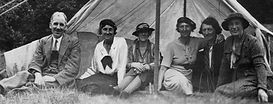
Mrs. Munro was Ian Munro’s mother and visited the 70th’s Summer Campsite near St.Catherine’s on Loch Fyne during the 7th Aug 1935. A photograph was included in the troop log of the six parents who visited that day, but the individuals have not been identified.
Murray, Lord James

During the 1930s, it was common for important members of the aristocracy to be appointed as County Commissioners or other roles within Scouting. Lord James Stewart-Murray was the 8th Duke of Atholl (1871-1942). He was educated at Eton and was a fluent Gaelic speaker. He was commissioned in the Royal Horse Guards and served in Kitchener’s expedition to the Sudan fighting at the Siege of Khartoum and the Battle of Atbara. He gained the DSO during the campaign and was promoted to Captain. He also served in the Boer War and raised a regiment of Scotsmen living in South Africa. In the 1st World War, he fought in the Dardanelles Campaign and had the rank of brigadier general by the end of the war. During the Second World War he served in the Home Guard. His full title was Brigadier-General His Grace, The Duke of Atholl, KT, GCVO, CB, DSO, PC. He also had a political career and was the MP for West Perthshire until 1917. In 1918, he was made a Knight of the Order of the Thistle. He also served as Lord High Commissioner to the General Assembly of the Church of Scotland until 1920, and in 1921, he joined the Privy Council. Between 1920-1931, he was Aide-de-Camp to King George V, and he was granted the Freedom of the City of Edinburgh.
Orr, Mr. Ryrie
Mr. Ryrie Orr lived at 35 The Esplanade and was one of the founder members responsible for starting up Greenock Scouting in 1909. He was also President of the Greenock Boy Scout Association from its inception until his death in 1943. As a result, Greenock Scouts viewed him as their own local 'Chief Scout' for over 25 years. Ryrie was also instrumental in starting up Paisley Scouting and was an ACC as a result of that. In 1911, he received Lord BP during his visit to Greenock, and he was instrumental in starting up the William Millar Scout Scholarships using a gift of £1000 from a local shipbuilder of that name. The scholarship was for the benefit of Boy Scouts such that they could take post intermediate courses at Greenock Academy or the High School. It was also used to assist entry to university or technical school. Ryrie Orr was a highly talented and accomplished man and was one of Greenock's leading citizens. He was the proprietor of the firm Orr, Pollock and Co which owned the Greenock Telegraph, and as such, he determined the policy and standard of the newspaper. It can be no coincidence that Scouting featured largely in the Telegraph during his years in charge. As well as having an active role in local and area Scouting, he was a philanthropist and was on the board of many local charities and organisations. The Troop Log identifies a number of events involving Ryrie Orr during the 1930s. On the 6th May 1935, he lit the bonfire that had been built by Greenock Scouts at the top of the Lyle Hill to celebrate the Silver Jubilee of King George V. At the Scout Swimming Galas held in 1935, 1936 and 1939, he gave speeches stressing the importance of swimming ability. On the 12th May 1937, he lit another bonfire at the top of the Lyle Hill, this time marking the Coronation of King George VI.
Park, John

Birth records suggest that this might be John Boyd Wilson Park who was born in the west end of Greenock in 1924. John was the son of John Park who, with his brothers, owned Allen McKechnie and Co, Butchers and Game Merchants. The family owned various shops in the district - the principal one being at the corner of West Blackhall and Argyll Streets. John lived 53 Finnart Street, and was the envy of some of his contemporaries as he owned at least two ponies, one of which was a Shetland and the other a larger one called 'Silver'. Jim Crawford recalled flying over the head of one of these ponies!
John attended Greenock Academy and had some academic and sporting successes. In 1931, he was in the junior 3 class and was second in the egg and spoon race at Sports Day. In 1933 and 1934, he won the three-legged race with Harold Hastie, and came third in the egg and spoon race in 1934. In 1936, he was in the senior 1 class and was second in Handcraft. The following year, he was in secondary I where he was first in Maths, Art and Handcraft. In 1939, he won the Spanish prize when he was in Secondary III.
John joined the 70th Troop during October 1934 and was probably placed in the Curlew Patrol with Eoin Steel as his PL and Wilson Hill as the Patrol Second. That was certainly the situation on the 20th March 1935 when a troop list was provided in the troop log. John attended the 1934 summer camp to Carradale and was in photographs taken at that camp. On the 4th-5th May 1935, he attended the Jubilee camp held at Everton to celebrate the Silver Jubilee of King George V. During 1935, he was making progress through his 2nd Class tests, but that seemed to stop in 1936. By October 1936, he was no longer attendingregularly, and he was removed from the Troop roll on 6th November 1936. However, he reappeared in 1937 and was reported to be last Scout of the Wood Pigeon Patrol. After that, there is no further mention of him. Jim Crawford confirmed that John Park was in the same class as many of the 70th Scouts who joined in 1934.
John left school early and joined the family business, but then the war broke out. Since he was a bit older than the rest of his classmates, he joined the army early on in the war. By this time, his love of ponies had given way to a passion for motor cycles, so it was not surprising that he should become a despatch rider. It was a dangerous occupation. Of the 20 or so in his original squad, only John and one other rider survived the war. After the war, John continued to live in Greenock, then later moved to Kilmacolm. His addiction for speed continued with an interest in fast cars. When this faded, he took to riding to hounds. In later years, the family butcher business amalgamated with Archie Jess to become McKechnie, Jess and Co.
Paterson, Colonel David
Colonel David Paterson DSO, TD, DL, Depute Lieutenant of the County was a member of the Finnart Church congregation, and he led the committee responsible for appointing the Rev. Stewart as minister following the departure of the Rev. Reid. He was also an important lay member in Greenock Scouting, where he was the District’s legal adviser and its vice president during the 1930s and early 1940s, becoming its president in October 1943 following the death of Ryrie Orr. Colonel Paterson was a strong supporter in the independence of Scouting and stated on several occasions that the Scouts should remain independent and unaffected by some of the government schemes that were being mooted during the early 1940s. He praised the Scouts voluntary style of discipline over the regimented discipline that was present in pre-service cadet corps. All the same, he thought a little more display of what the Scouts had to offer young people would increase their ranks. Colonel Paterson liked to work in the background, and it is quite possible that he was influential in encouraging the start-up of the 70th Troop and its continuing success, especially since he was a regular supporter of District Scouting. It is possible that Colonel Paterson served with the Glasgow Chamber of Commerce Battallion of the 17th Highland Light Infantry. A book was written in 1920 covering the war record of the battallion, with a contribution from a Major Paterson DSO MC. Colonel Paterson was one of the VIPs who reviewed the military march past at the Battery Park on King George VI’s Coronation Day during 1937. Going from the sublime to the ridiculous, he also contributed towards the costs of the 70th’s new trek cart in 1939. Colonel Paterson was a lawyer and a partner at Neill Clerk and Murray Solicitors. He lived at Clyde House, Roseneath Street and had a son, Major David L. E. Paterson MC.
Paterson, Mr.
Mr. Paterson was the farmer who owned the land on which the 70th Scouts camped during the 1934 Summer Camp to Carradale. The campsite was on the NE part of the peninsula leading to Carradale Point. Mr. Paterson also had a shop and the Scouts purchased most of their food from Mr. Paterson during the camp.
Phillips, Eric - click here for Scouts and Leaders (1939-1945)
Philp, Rev. Alexander
The Rev. Alexander Philp was an active member of Greenock District’s Local Scout Association during the 1930s and acted as Chairman of the Association. He was originally from Perth and served as an assistant minister at Dunblane Cathedral before moving to Greenock to be minister of the North Church (also known as the Old West Church). He conducted the Drumhead Services held at Pirrie Park in 1935 and 1936 with the addresses being provided by the Rev. D. Troup in 1935 and the Rev. E. Rathbone Lee in 1936. The Rev Philp also opened the new Scout Chapel at Everton on the weekend of the 4th-6th April 1936 when a dozen 70thScouts were in camp. On the 29th November 1936, a District Parade to the Old West Kirk was held, and the Rev. Philp gave the address during the Church Service. In 1947, he left Greenock and became minister of Ladybank Church near Cupar.
Preston, Commander
During 1935 and 1936, Commander Preston was active in supporting the 70th in several ways. For example, on the 4th-5thMay 1935, he helped transport camping equipment and personal kit to Everton for a weekend camp involving a dozen Scouts attending the Jubilee Camp which had been organized to celebrate the Silver Jubilee of King George V. On the 10th May 1935, he paid a visit to a Troop meeting. He paid another visit to the troop on the 8th November and donated two boxes of fireworks as prizes for a competition; the winners being Alistair McGregor and Brian Wickham. He paid further visits to troop meetings on the 31st January and the 21st February 1936. Finally, during the summer of 1936, he drove to the Troop’s summer camp at Ballinluig on the 7th August and took the Rev. Reid, Ian Dunlop and Rover Scout, Archie Brown to visit Blair Castle which had only recently been opened up to the public. Unfortunately, it is not known who Commander Preston was or what kind of links he had with the troop. There was certainly no 70th Scout by the name of Preston, but there might have been a Wolf Cub of that name. Alternatively, he might have been asked to instruct the Scouts on a specialist skill such as signalling.
Rae, Molly - see Edridge, Molly

Ramsay, David
David Stewart Ramsay was born in Greenock West in 1924. He was very friendly with the Steels and he stayed diagonally opposite them in Margaret Street. David was a pupil at Greenock Academy where he was in the same class as Harold Hastie, Sandy Campbell and Jim Crawford. His name appears quite frequently amongst the prize winners at the school’s Sports Days. In 1933, he was second in the egg and spoon race and was in the winning tug of war team for the junior school. In 1934, he was in the junior 5 class and was first in the egg and spoon race and second in the hurdles. In 1935, he won the pillow fight and was fourth in the sack bumping. That year, he also won the Fraser Writing Prize. In 1937, he was 3rd in the under-15's cricket ball, 1st in the under-14’s cycle race and high jump, and finally 3rd in the sack bumping.
David first appeared at a 70th troop meeting along with his friend Hamish Steel on the 24th January 1936, and their applications to join were then approved by the Court of Honour on the 31st January 1936. It is likely that he was placed in the Curlew Patrol with Eoin Steel as his PL. He passed his Tenderfoot Badge on the 28th February 1936 and was invested on the 6th March along with Jack Shipston, Hamish Steel and James Brodie, His first camp at Everton was on the 4th-6th April 1936 when the 70thmoved away from central cooking and introduced a system where the Scouts paired up to camp and cook all their own meals. David paired up with Lawrence Harvey for that weekend. He also attended the Troop’s Summer Camp of 1936 at Ballinluig from the 2nd - 16th July. During the camp, 5 Scouts including David took the bus into Pitlochry to go to the cinema. In the troop log, Ian Hardie wrote rather gleefully, “All these picture-fans, it is gratifying to note, missed the last bus and had to walk 5 miles home for their supper and bed”. A Mock Trial was also played out during the camp with David playing the role of the accused, charged with poaching a salmon from the River Tay.
In terms of badgework, David slowly worked his way through a number of 2nd Class tests between 1936 and 1938. However, there is no record of him completing the badge. It is also not known whether he obtained any Proficiency Badges.
On the 28th May 1937, he was 4th Scout in the Curlew Patrol with Wilson Hill, now as PL. In September 1938, he paired up with PL Archie Brown to form a new Owl Patrol. It is likely that this was a patrol set up for any older Scouts who wished to join it. It is not known how long David stayed in the troop after that, but he eventually went to boarding school at Fettes school. After school, he qualified as an accountant and worked in Bathgate with a steel firm before becoming a director and secretary at Yarrows Shipbuilders. He eventually moved to New Kilpatrick, East Dunbartonshire.
Ramsay, Mr. A.
Mr. A. Ramsay was a Badge Examiner in Greenock District during the 1930s. He assessed Lawrence Harvey for the Artist Proficiency Badge on the 10th July 1935.
Reid, Reverend A.R.R. MA, DD
The Reverend Reid was minister of Finnart Church from 1930 to 1936 - a mere 6 years - but he is the man who inspired the start of the 70th Scout Group connected to the church. He was born in Edinburgh in 1895 and studied for the ministry at Edinburgh University and New College, then served for 5 years at the Church of Scotland in Bombay from 1924-1929. For a time, he served as a lieutenant with the H.L.I. He was married and had two sons (Ronald and David) during his period in India. He returned to the UK in 1929 and took up his post at Finnart Church in 1930. To begin with, he stayed at the manse in Union Street but eventually moved to the end house in 109 Finnart Street (Kilmory) (later renumbered to 209). It is remarkable that he showed any interest in a Scout group since he had plenty of other problems on his mind. In 1932, the church was suffering a long catalogue of problems that included damp, plumbing leaks, gas leaks, over excessive consumption of electricity and roofing problems.

He was clearly interested in the Scouting movement though. In June 1932, he took the annual open-air District Scout service at Pirrie Park and this may have been one contributing factor in his decision to have a Scout troop at Finnart Church. At that service, he gave the address from St. Matthew's gospel ('Let your light shine before men that they may see your good works and glorify your Father which is in Heaven').
Although he does not seem to have been involved in the running of the troop, it is clear that he had a keen interest in it. He camped several days with the Troop at three of its Summer Camps during the 1930s – a week at Carradale (1934), and 4 days each at St. Catherine’s (1935) and Ballinluig (1936). His son Ronald recalled him wearing an ex army khaki kilt as he left the house for those visits. A photograph of the Reverend Reid at Carradale was included in the Troop Log but has sadly gone missing. However, photographs survive of him at later camps. Those reveal that he was perfectly happy to get involved in various camp activities, such as swimming in the River Tay at Ballinluig and hiking to Cairndow and back at St. Catherine’s. A photograph taken at St. Catherine’s has a caption identifying him as being the ‘trainer’ of the 70th’s ‘football team’. However, this was probably written in jest and merely indicated that the photograph included 11 Scouts and leaders. He also owned a camera and took film of various activities at St. Catherines including one peculiar activity called ‘Hitler’s manoeuvres’. This might have been some form of wide game, but the details were not recorded. Only the Rev. Reid’s film could clear up that puzzle, but it is not known whether it still survives. At Ballinluig in 1936, he joined Ian Dunlop, Commander Brown and Rover Scout Archie Brown on a visit to Blair Atholl, only weeks after it had been first opened to the public. The Rev. Reid’s willingness to camp with the Scouts and participate in camp activities was felt sufficiently newsworthy by the Greenock Telegraph to comment on each of his visits.
The Rev. Reid’s interest in the Troop was not restricted to summer camps, and he was a frequent visitor at Troop meetings. Several of those ‘drop-in visits’ were recorded in the Troop Log (e.g. 26th Apr 1935, 18th Oct 1935, an 1st Nov 1935. There were also more formal interactions. For example, during the 1930s, the Troop had monthly parades to Finnart Church to attend Sunday church service led by the Rev Reid. In addition to this, there was a particularly important ceremony carried out on the 19th January 1936 when the newly purchased Troop Colours were presented and dedicated by the Rev. Reid. Such an occasion merited a District Parade to Finnart Church involving all the Packs and Troops in Greenock. During the service itself, the Union Jack was to be carried by Eoin Steel with an escort of Ronald Grant and Archie Stalker, while the Troop flag was to be carried by Alan Hardie with an escort of Lawrence Harvey and Wilson Hill. The flagbearers and escorts knelt at the corners of the front platform, and the minister dedicated the flags before presenting them to each flagbearer. He then addressed the congregation as described in the following Greenock Telegraph’s account of the ceremony);
‘ “Never be ashamed of your flags. They tell what a man is fighting for and the side he is on.”
With these striking words, Rev. A.R.R. Reid dedicated the 30th Group of Boy Scouts’ Colours in Finnart Church on Sunday. Close on 400 boys, representing the Scout and Cub branches of the movement in Greenock, Gourock and Inverkip took part in the service, and included among the officials were Mr. Arthur Muir, County Commissioner; Mr H. W. Butters, District Commissioner; Mr. J. J. Swan, Assistant Commissioner.’
‘ “Just think what some flags mean,” said Mr Reid. “They must be true to the Union Jack. It brought them truth, justice and liberty. That is what is meant, and when they were trusted like that it made their responsibility as Britishers very great. They had to work hard, and to think hard to be true to it. Wherever the Union Jack flew, at home or abroad, people knew they could depend upon the British for fair play, justice and freedom. They could realise the great honour it was to be trusted with a flag. In the old days before a flag was given to a young soldier, he spent the night in prayer, asking God to give him strength, and to keep him true to his colours. That was why they had come to church to see the 30th Group getting their colours. They knew that if they were to be loyal and true to their colours they must have God to help them.” ‘
The Rev. Reid was also more than willing to support the Troop from the pulpit if required. In September 1934, there was an initiative to attract more recruits for the troop which involved a statement in the Greenock Telegraph’s ‘Scout Notes’ and a pulpit appeal from the Rev Reid. This resulted in nine new recruits to the troop in October 1934, eight of whom have been identified as Archie Brown, Jim Crawford, Harold Hastie, Alistair McGregor, James McNeil, John Park, Sandy Campbell and Brian Wickham.
The Rev Reid was also the chaplain of HMS Carrick - the local base for the Royal Navy Volunteer Reserve (Greenock subdivision) from 1931-1936. He led another District Service at Pirrie Park in 1935, before leaving Greenock in June 1936 to become minister of Belmont Church in Glasgow. There were generous tributes made to him in the Greenock Telegraph which praised him for building up the congregation of Finnart Church - one of the reasons why Belmont Church was so keen to recruit his services. Mr. J.B. Hutchinson of Finnart Church stated that the congregation felt that they were ‘losing a best friend but that everyone wished him well. He would be difficult to replace. Mr. Reid had been an inspiration and a living force.’
The troop posted him a book token worth a guinea to mark his departure. A letter of thanks was received and read out at the COH on 6th Nov 1936. It is not known whether he made any further contact with the Troop after that. A 'Mr. Reid' is reported to have taken films of the troop which were shown on 15th December 1939, and this might have been the Rev Reid. In 1940, he served as a chaplain in the navy for three years before returning to Belmont Church in 1943. That year he also gave the watch night service on the radio on Hogmanay 1943 from 11.45-12.05.
After the war, he continued as minister of Belmont Church and supervised a successful union with Hillhead Parish Church during 1949/1950. Belmont Church itself became part of Laurel Bank school. In 1957, he moved to take up a parish in Cleish, Fife near Kinross and Loch Leven. When he retired, he moved to Kippen where his main hobby was painting in water colours.
George Brown who was Troop Leader during the war remembered the Rev Reid as being 'a very nice man'.
Reid, David
David Reid was the second of five sons fathered by the Rev. Reid, and was born in Bombay about 1926. During his six years in Greenock, he was a pupil at Greenock Academy and picked up some prizes at the school’s Sports Days. In 1933, he was in the junior 2 class (primary 2) and was second in the 100 yard sprint and egg and spoon race. In 1934, he was second in the 100 yards again. In 1936, he was third in the sack race. He also won the Fraser writing prize in 1935 and 1936. His brother Ronald recalls that both he and David were in the 70th Cubs. If so, they must have joined either at the start of the pack or very soon afterwards, since the family moved to Glasgow in the summer of 1936. David became a minister, following in his father's footsteps.
Reid, Ronald
Ronald Reid was the eldest of five sons fathered by the Rev. Reid and was born in Bombay about 1925. He was at Greenock Academy during his six-year stay in Greenock. In 1935, he was in the junior V class and was first in the sack race and second in the three-legged race at the school’s Sports Day. He followed this up in 1936 by being third in the sack race and first in the three-legged race. Ronald recalls being in the 70th Cubs, and he may well have had a short stint in the Troop before the family moved to Glasgow in the summer of 1936. George Brown remembered him wearing a greenish blue kilt. Ronald graduated as a doctor and eventually emigrated to Australia. However, before he emigrated, he featured in the Greenock Telegraph as a local hero for rescuing someone from drowning near the Gourock Yacht Club.
Ritchie, Mr. Archibald
Mr. Archibald Ritchie was District Scoutmaster and may have taken over the role after Sam Faulds resigned. He was responsible for the District Parades associated with the dedication of the 7th Group’s Colours on the 13th October 1935 and the 70th Group’s Colours on the 19th January 1936.
Ritchie, Billy

Billy Ritchie's father (James) was the photographer who took the group photo of September 1937. He was with Robert Aulds photographic business at 38 Union Street at the corner with Campbell Street. Billy is present as a Cub Seconder holding the Pack's totem pole. There is no other mention of him in the Troop records, and he did not join the Scout troop. Little else is known about him and he is believed to have moved abroad. The Telegraph mentions a W. Ritchie who won the pillow fight in 1936 when he was in the junior 6 class. If this is him, it would imply that he was born about 1925. There is also a notice of a William L. A. Ritchie gaining a school leaving certificate from the Academy in 1942.
Salmon, Mr. Ernest
Ernest Salmon was a Rover Scout Leader who served on the District Executive (the Local Association) during the 1930s. He also served on the Executive’s social sub-committee and was Chairman of the District’s Rover Scout Council which was responsible for overseeing Rover Scout training and activities. During 1934, he was appointed as Camp Skipper for Everton and District Rover Scout Leader, and in 1935, he was appointed Convener of the Competitions Committee which included responsibility for organising the Shannon Cup and the Scout Swimming Gala. His name crops up several times in the Troop Log in association with those duties. Thus, he visited Everton during the Shannon Cup Competition of 1935, which was won by the 70th, as well as the Swimming Gala held in 1935. He was also present with H.W. Butter at a 70th’s Court of Honour Meeting on the 5th March 1937.

Shipston, Jack
Nothing has been discovered to date regarding the personal background of Jack Shipston (or Skipston). He joined the Troop on the 29th February 1936 and passed his Tenderfoot on the same night, along with David Ramsay. He was then invested on the 6th March 1936 along with David Ramsay, Hamish Steel and James Brodie. He may well have been placed in the Curlew Patrol with Eoin Steel as his PL, as he was certainly in that patrol on the 27th May 1937, by which time Wilson Hill was Patrol Leader. Jack passed several 2nd Class tests during 1936 and also attended a weekend camp at Everton on the 4th-6th April 1936, where he was paired up with Alan Hardie. This was the first camp where the Scouts formed pairs to camp and cook all their own meals. There are no further references to Jack in the troop records after the 28th May 1937, and it is not known when he left the troop or what he did after that.
Smith, Mr. J.
Very little is known about Mr. J. Smith other than he was an Assistant Cub Scout Master with the 70th’s Wolf Cub Pack during the first half of 1936. The Troop Log refers to him being present at a joint Cub/Scout meeting on the 4th June 1936 where films were shown. It is also likely that he was the ACM identified in a plan that was drawn regarding the Draping Ceremony of the Troop Colours on the 24th January 1936.
Smith, J. Nicol K.

Nicol Smith's full name was James Nicol Kynoch Smith and he was born in 1924 in Anderston, Glasgow. It is not known when the family moved to Greenock, but they lived at 14 Brisbane Street. Nicol’s parents were associated with Kennedy and Co. Monumental Sculptors with a yard at the foot of South Street, opposite the cemetery gates. Nicol was friendly with Sandy Campbell who was in the same class at school. Sandy's sister (May Ogilvie) remembered Nicol as being a nice boy and an only child. At the school Sports Day of 1933, Nicol was in the winning tug of war team for juniors in 1933. Once he was in the Secondary school, he was second in Handwork in 1937, and played in the school’s first XI cricket team in 1940. In 1941, he was in secondary V and won prizes in Maths and Science.
There is evidence to indicate that Nicol joined the troop in February 1935 and placed in the Wolf Patrol. He may have had Duncan Black as PL for a short while before Duncan resigned and Archie Stalker took over as Acting PL. It is not known when Nicol gained his Tenderfoot Badge and got invested, but he was awarded his 2nd Class Badge on the 7th February 1936, one year after joining. By the 28th May 1937, he had joined the Curlew Patrol with Wilson Hill as PL. During gthe summer of 1937, he attended summer camp at Ballinluig and was in the group photo taken in September of that year. In September 1938, he was promoted to SPL of the Curlew Patrol under PL Ian Munro. As a result, he was entitled to attend Court of Honour (COH) meetings, and there are various entries in the COH minutes involving him. In November 1938, he was elected as Secretary and Treasurer of a football committee that would coordinate the troop's participation in a District football competition. In June 1939, he and PL Jim Crawford took part in two parades during Scout Week, where they dressed up to represent a couple of Proficiency Badges (the Mason’s and Athlete’s badges respectively). He attended the Troop’s Xmas party in 1939, and was on a day trip to Everton during March 1940. On Thursday 28th March 1940, he and Ian Munro did their 1stClass journey to Arrochar on bicycles, suggesting that Nicol may well have been close to gaining his 1st Class badge. Unfortunately, it is not known whether he completed the badge or not. He finally resigned on the 27th September 1940, along with A. McGregor and D. Woodward, due to business, home guard and other duties.
Nicol was in the Royal Armoured Corps during the war and was commissioned in 1944. He served in NW Europe where his tank blew up after running over a mine. As a result, he lost one foot and part of his leg. According to May Ogilvie, this had unfortunate consequences. For example, Nicol was meant to be Sandy Campbell's best man at Sandy's wedding, but Nicol could not wear the kilt. Nicol gained a degree in electrical engineering and worked with a firm called Lucas. He died quite young and it is probable that his wounds contributed to an early death.
Smith, Mr. R.

Mr. R. Smith was an Assistant Scoutmaster with the 1st Gourock (Colonel Darroch’s Own) Scout Troop. He and Sam Faulds ran a joint Summer Camp involving the 70th Renfrewshire and 1st Gourock Troops at Ardrishaig in 1933. There were twenty Gourock Scouts attending as opposed to six 70th Scouts.
Smyth, Bill - click here for Scouts and Leaders (1939-1945)
Stalker, Archie

Archie Stalker was born in 1921. His father was a clothier and tailor who lived at 5 Robertson Street, Greenock. Archie was in the same class in Greenock Academy as Sandy Campbell's sister (May Ogilvie). In 1936, he was in the senior 3 class and won the English prize.
Archie was one of the earliest Scouts to join the 70th, and there is evidence to indicate that he did so during November 1932 at about the same time as Wilson Hill and Eoin Steel. It was probably placed in the Wolf Patrol on joining, as he was recorded as being Patrol Second of that Patrol in October 1934, with Eoin Steel as his PL. On the 15th March 1935, Eoin Steel moved Patrol to take charge of the Curlew Patrol – an indication that Duncan Black had recently resigned. Archie was appointed as ‘Acting Patrol Leader’ for the Wolf Patrol which meant that he was in charge of the Patrol but remained a Patrol Second in terms of rank. However, on the 7th June, Archie
was formally promoted to Patrol Leader with Jim Crawford appointed as his Patrol Second. One of his first duties as a fully-fledged PL was to join Alan Hardie, Eoin Steel and Ronald Grant in raising the flag at Pirrie Park for the District’s Annual Drumhead Service. He was also involved in the dedication ceremony for the Troop’s new Colours on the 19th January 1936. During the dedication service, the Union Jack was to be carried by Eoin Steel with an escort of Ronald Grant and Archie Stalker, while the Troop flag was to be carried by Alan Hardie with an escort of Lawrence Harvey and Wilson Hill. The flagbearers and escorts knelt at the corners of the front platform, and the minister dedicated the flags before presenting them to each flagbearer. After the dedication service, the colour party paraded the colours past the platform party on Union Street, and it is likely that they were at the front of the District Parade as it marched to George Square before dismissing.
There is no evidence of Archie being interested in badgework or outdoor camping, and he certainly did not attend any of the Troop’s Summer Camps. However, the available records suggest that he was a trusted and reliable member of the Court of Honour (COH). For example, he was appointed as treasurer of the COH in November 1936, and was reappointed in October 1937. Archie remained as Patrol Leader of the Wolf Patrol for 3 years before resigning on the 9th September 1938. He was instantly promoted to Troop Leader. However, he resigned from that position later that same night, whereupon the COH asked him to stay on as honorary treasurer, even though he was officially no longer a member of the 70th group. This he agreed to do, and he continued as treasurer until the 28th April 1939.
Archie Stalker remained in Greenock and worked in the Provident Bank when he left school. During the war, he served in the Royal Corps of Signals in India from 1942-1945, returning home in April 1945, before getting transferred to Germany. After the war, he returned to work with the Provident Bank until he retired. He was on the musical festival committee. Archie had a brother called P. J. (Ian) Stalker who was also in the Royal Corps of Signals and served in the Far East before he was captured by the Japanese. As a prisoner, he survived the sinking by torpedo of a Japanese ship carrying POWs from Thailand to Japan and was taken to a POW camp at Fukuoks.
Steel, Eoin

Eoin Steel was born Ian Simpson Steel in 1919 and lived at 39 Margaret Street; the family may also have lived on the Esplanade at some point. Ian eventually changed the spelling of his name to Eoin, but it is not known why. He came from a large family that consisted of five sons (Bill, Alistair, Donald, Eoin, Hamish) and one daughter (Elspeth). The sons (particularly Alistair) were very good rugby players and were the backbone of Greenock Wanderers for many years, while the father (William) is said to have held the Wanderers together during the war years. William was a master builder who owned a yard in Jamaica Lane. He was responsible for constructing a well-designed building on the NE corner of Margaret Street and Union Street just after the First World War.
The Steel family were strong supporters of the 70th troop. William contributed a pound towards the troop's trek cart
in 1939, while Eoin's older brother (Donald) supplied a lorry to help the Scouts move paper during the war years. Eoin's mother (Annie Rankin) was by all accounts a very strict woman, and apparently many childhood friends of the Steel boys lived in fear of her. She was known to have chased naughty children along the streets of Greenock and through the undergrowth. On the other hand, she supported the Troop on several occasions. The COH minutes of November 1935 state that 'a sum of money (5/-) was devoted as a slight gesture of appreciation to Mrs. Steel and Mrs. Cook for their benevolent cooperation in the matter of the troop meetings'. Unfortunately, there is no clue what that cooperation involved. It is known that Mrs. Steel contributed baking towards the Troop's Christmas parties and it may have had something to do with that.
Eoin attended Greenock Academy and there are references to some of his performances at Sports Days. In 1932-33, he was in the senior II class and won the under 15’s cricket ball with a throw of 60 yards at the 1932 Sports Day. He was also in the winning tug of war team for the seniors and won the pillow fight. In 1934, he won the pillow fight again and came second in the cricket ball. The following year he was in the senior IV class and came first in the pillow fight and 100 yards sprint, second in the broad jump and third in the high jump. Finally, in 1937, he was 2nd in the 100 yards sprint and third at the shot putt. On the academic side of things, he won a William Miller Scholarship of £3.10 from the local Boy Scout Association for the academic year 1935-36. He also won a French prize in 1937. From this record, it was clear that Eoin was an athletic, fit individual and his record at Scout swimming galas (see later) back this up.
There is a strong possibility that Eoin was in a different troop when the 70th started up in 1932. However, Alan Hardie was a close friend and encouraged him to join the troop very soon after its creation. Eoin joined in November 1932 at about the same time as Wilson Hill and Archie Stalker and was then promoted to Patrol Leader of the Wolf Patrol, probably during the early part of 1933. It seems highly likely that Eoin, Alan Hardie and Duncan Black were the 70th’s first PLs. On the 15th March1935, Eoin was appointed Patrol Leader of the Curlew Patrol following the resignation of Duncan Black, then in November 1936, he succeeded Alan Hardie as Troop Leader and held that position until September 1937 at which point, he joined the Rover Crew.
Eoin was a regular camper as a Scout and attended four summer camps at Ardrishaig (1933), St. Catherine’s (1935) and Ballinluig (1936 and 1937). The recent discovery of the Troop Log from the 1930s has provided more detail regarding those camps. With respect to the 1935 Summer Camp, most of the party travelled to St. Catherine’s via Inveraray on the steamer ‘King George V’. However, Alan Hardie and Eoin disembarked at Dunoon and cycled the 23 miles to the campsite, possibly arriving ahead of everyone else. A couple of days later, Alan and Eoin cycled round the head of Loch Fyne to Inveraray with the intention of camping at Furnace and then returning the next day. However, they had to abandon that plan due to horrendous midges and return the same day. The 1936 Summer Camp at Ballinluig was a sharp contrast to 1935 in having fine weather and no midges. A lot of swimming and sunbathing took place and on one of the days, Eoin Steel, Alan Hardie and Ian Hardie walked almost to Dunkeld and back in a single afternoon. That same threesome were heavily involved in the construction and repair of a diving platform into the River Tay beside the campsite. At the 1937 Summer Camp, Ian Hardie and Eoin Steel cycled to Blair Atholl Castle and back.
Eoin also led a Patrol at the District’s Jubilee Camp held on the 4th-5th July 1935 to celebrate the Silver Jubilee of King George V. Other camps attended byy Eoin included a weekend camp at Everton on the 23rd-24th June 1935 with Ronald Grant, Lawrence Harvey and Alan Hardie, as well as a week-long Everton camp with Alan Hardie during the summer of 1935. It is possible that he may have been PL of the 70th Patrol entered for the Shannon Cup in 1936. However, no details were recorded regarding the patrol members or how well they performed. Eoin was also a member of the 70th swimming teams that won the Victory Trophy at the Scout Swimming Gala two years in succession (1935 and 1936).
Scout Troops in the 1930s participated in a lot more Church parades than in later decades. For example, the 70th had a monthly parade to Finnart Church to attend Sunday Service. There was also an Annual Djstrict parade to Pirrie Park (later renamed Rankin Park) for an open-air Drumhead Service. On the 10th June 1935, the 70th were given the honour of raising the flag at the Park – a task that was carried out by Eoin Steel, Archie Stalker, Alan Hardie and Ronald Grant. Another important event took place at Finnart Church on Sunday 19th January 1936, when the newly purchased Troop colours were dedicated by Rev. Reid then presented to the flagbearers. Eoin Steel had the honour of being the flagbearer for the Union Jack, while Alan Hardie carried the Troop Colours. The Packs and Troops from all the other Greenock Scout Groups were present and once the service was over, there was a grand Parade from Finnart Church to George Square with the 70th colours leading the way.
Surprisingly, there is very little information in the Troop records regarding Eoin’s progress through the Scout training scheme. It would seem likely that he gained his 2nd Class badge, but there is no evidence of him gaining his 1st Class badge. However, he did gain a clutch of Proficency Badges during 1936, namely the Athlete, Interpreter, Pathfinder, Artist and Swimmer.
As stated earlier, Eoin resigned as Troop Leader in September 1937 and left the troop to join the Rover Scouts. However, six months later, Eoin returned to the Troop and applied for a warrant as an ASM. This was approved by the COH on the 1st April 1938 and Eoin regularly attended Troop nights and Court of Honour meetings from then on. One of Eoin’s responsibilities was to organise and train the 70th swimming team for the 1938 Annual Swimming Gala. Entries were submitted for the Victory Trophy, an Inter-Group race and the Scout Championship. There was not much success in terms of the Scout Championship, but the 70th came second in the Victory Trophy and won the Inter Group relay race. In addition, Ronald MacKay won the Novice’s Cup and Alan Hardie won the Rover Scout Championship. There was even more success in 1939 when the 70th won the Victory Trophy, the Novice’s Cup and the Rover Scout Competition. However, there is some confusion over who won the last event. The front page of the Troop log identified the winner as Alan Hardie, whereas the relevant entry within the log identified the winner as Eoin Steel himself.
Considering Eoin’s physique and his record at GA Sports Days, it is likely that he was good at a range of sports, which is probably why he was given the responsibility of leading the Troop's football committee in 1938. Towards the end of 1938, he was also given the task (along with Ian Dunlop and Dick Leggett) of exploring whether it would be possible to store camping equipment in the church cellar - later to become the 'dunny'. The dunny was used extensively by the 70th in years to come for all sorts of purposes.
It is clear that Eoin was a keen ASM and good at motivating Scouts, because he was commended in November 1938 for producing a substantial increase in attendance figures. Eoin may have been particularly friendly with SM Ian Hardie, for on the 3rd March 1939, he made a speech at which Ian was presented with a fountain pen from the troop to mark his departure. From that point on, it is likely that Eoin was the de facto Scout Master and in June 1939, Eoin played a significant role in the organisation of Scout Week and received thanks from the District in the Scout Notes of 6th June.
When the Second World War started, Eoin organised the collection of waste paper for the war effort from Mr. Taylor, Rector of Greenock Academy. In November 1939, Ian Dunlop resigned as GSM leaving Eoin and Wilson Hill to run the troop single handed for the next couple of months. Eoin was the senior figure of the two and continued as acting Scoutmaster and chairman of the Court of Honour. With Wilson, he organised a Christmas party for the troop and a hope was expressed in the COH minutes that Mrs. Hill and Mrs. Steel 'would again contribute to the eating side with some splendid specimens of their delightful cooking'. Work continued on clearing out the church cellar with Eoin and Wilson describing an atmosphere that was 'positively foul'. Eoin Steel’s last meeting with the troop was on the 26th January 1940, since he had been called up for military service. His departure was mentioned in Scout Notes of 30th January and this reveals that he had been Camp Skipper at Everton from October 1938 and had been extremely popular with all ranks camping at Everton. During the rest of the war years, he made the occasional 'surprise visit' on the 70th when he was on leave. For example, he took part in troop meetings on the 7th March 1941, 10th October 1941, 29th May 1942 and 8th September 1942.
It is believed that Eoin served in the RAF as ground crew or administration. He survived the war and lived near Fort Matilda station, working as the transport manager for a fondant-producing firm called Fergusons. After he retired, he could sometimes be seen at Tescos, working on the trolleys. His wife Sarah taught music to a very high standard and many of her pupils entered the music festival. Eoin was a member of St. Luke's church and has been described him as 'a nice fellow' by those that knew him.
Steel, Hamish

Hamish Raibert Simpson Steel was born in 1924 and was the youngest son of William and Annie Steel. He lived at 39 Margaret Street and had one sister and four brothers including Eoin (see above). He attended Greenock Academy and featured in some of the school’s Sports Days. In 1933, he was in the winning junior team for the tug of war. In 1935, he was in the junior VI class and came second in the pillow fight and the hurdles. In 1938, he was in a winning relay team.
Academically, he won the Fraser Writing Prize two years running in 1935 and 1936. When he was in secondary I (1937) he was first in Latin. He left school in 1942.
Hamish first appeared at the 70th on the 24th January 1936, along with his friend David Ramsay. Their applications for membership were then approved on the 31st January 1936. Hamish gained his Tenderfoot Badge and was invested on the 6thMarch 1936, along with David Ramsay, Jack Shipston, and James Brodie. It is not known into which Patrol he was first placed, but by the end of May 1937, he was 1st Scout in the Fox Patrol with Lawrence Harvey as his PL and Harold Hastie as his Patrol Second. Hamish made steady progress through his 2nd Class tests throughout 1936 and 1937, and he finally received his 2nd Class Badge on the 28th May 1937.
Hamish’s first camp was a weekend camp at Everton held on the 4th-6th April 1936. At this camp, the 70th abandoned central cooking for the first time and adopted a scheme where the Scouts were paired up and cooked all of their meals in pairs. At this camp, Hamish was paired up with Bill Ingles. Following this camp, Hamish attended the 70th’s Summer Camp held at Ballinluig on the 2nd-16th July 1936. This was perhaps the most enjoyable Summer Camp of the 1930s due primarily to fine weather and an absence of midges. As a result, there were plenty of opportunities for bathing in the River Tay and sunbathing out of it. There were also a number of visits to the cinema in Pitlochry. On one such occasion, Hamish and four other Scouts missed the public bus back to Ballinluig. Ian Hardie gleefully wrote the following in the troop Log, “All these picture-fans, it is gratifying to note, missed the last bus and had to walk 5 miles home for their supper and bed.” Given the success of this camp, it was no surprise that Hamish also attended the 1937 Summer Camp held on the same site.
Hamish was still 1st Scout of the Fox Patrol in September 1938, this time with Jim Crawford as PL and Ian Curtis as Patrol Second. However, in 1939, there was a reorganisation of the Patrols which saw the Fox Patrol being renamed the Wood Pigeon Patrol with Jim Crawford still as PL and Dennis Woodward now as SPL. Hamish, himself, was never promoted and left the troop on the 3rd November 1939.
During the war, it is thought that Hamish served in the navy, but little is known about this. After the war, it is believed that he was the only one of the Steel brothers to go to university and it has been suggested that he attended St. Andrews University. There is some disagreement about this though. At the time of his death, he was studying for a degree in hotel management, and one wonders whether St. Andrews would have been providing such a course at that time. On the other hand, he might have started a course at St. Andrews then switched courses and University. He apparently struggled with his studies and it is said that he succumbed to deep depression. In the early hours of the 22nd January 1948, he woke up in the early hours of the morning, left his parents house and walked down Margaret Street to the Esplanade. He then walked down one of the slipways into the Clyde and drowned himself. His body was found in the river next morning opposite Johnston Street. He was 23 at the time.
Steel, Mr. and Mrs.
Mr.William and Mrs Annie Steel were the parents of one daughter and four sons, two of whom joined the Scouts (Eoin and Hamish). They lived at 39 Margaret Street. William was a master builder who owned a yard in Jamaica Lane and was responsible for constructing a well-designed building on the NE corner of Margaret Street and Union Street just after the First World War.The Steel family were strong supporters of the 70th troop. William contributed a pound towards the troop's trek cart in 1939, while Eoin's older brother (Donald) supplied a lorry to help the Scouts move paper during the war years. Eoin's mother (Annie Rankin) was by all accounts a very strict woman, and apparently many childhood friends of the Steel boys lived in fear of her. She was known to have chased naughty children along the streets of Greenock and through the undergrowth. On the other hand, she supported the Troop on several occasions. The COH minutes of November 1935 state that 'a sum of money (5/-) was devoted as a slight gesture of appreciation to Mrs. Steel and Mrs. Cook for their benevolent cooperation in the matter of the troop meetings'. Unfortunately, there is no clue what that cooperation involved. It is known that Mrs. Steel contributed baking towards the Troop's Christmas parties, and it may have had something to do with that.
Stewart, D. H. Reverend

Donald H. Stewart was born in 1899 in Inveraray, Argyll, where his father was the minister of the UF church for many years. Having grown up in Inveraray, he left school to train for the ministry. It is not known how many charges he had, but he was the minister at St. John's at Edenside, Kelso for four and a half years before taking over the ministry of Finnart Church in 1937 following the departure of the Reverend Reid in 1936. The Rev. Stewart was the church’s fourth minister and was welcomed to his new charge at a social meeting at the Lorne hotel which was given full coverage in the Greenock Telegraph. His predecessor, the Rev Reid, sent a letter expressing deep regret for his absence and wishing Mr. Stewart the utmost joy and
blessing in his new charge. A spokesman at the meeting stated that Finnart Church had taken a full year to appoint their new minister, searching long and hard, because they wanted to get the right man. In the end, they had selected a man who came ‘with no recommendations except his own brain and ability’. His real recommendation was ‘his personality, sincerity and sound judgment’. There was also a reference to the Rev. Stewart’s love of the Highlands, its lore and spiritual traditions. Colonel D. Paterson DSO spoke on behalf of the congregation stating that there had been some anxiety that they would ever find the right man for the job, but as soon as they heard the Rev Stewart preach at Finnart Church, they knew he was the best man. His appeal was in his ‘attractive personality, obvious sincerity’ and ‘his broad and clear presentation of the gospel message’. The Rev. Stewart replied that his invitation had been so unanimous that he felt it was a call from the church itself and that he could not possibly refuse . He said simply, "I have no programme to announce or plans made for my ministry except to work hard and to give you all I have in faithfulness to duty."
He remained as minister until 1968 and was always a strong supporter of the 70th Scout Group. His first visit to the Troop might have been on the 28th May 1937, when he carried out an inspection. There is also an entry in the Court of Honour Minutes regarding an issue that had created quite a debate within local Scouting circles. For some time, the District had arranged a District Armistice Parade to mark Armistice Day. However, the District eventually decided to discontinue the Parade and advised Groups to attend their own Church instead. At a Court of Honour (COH) meeting held on the 3rd December 1937, Harold Hastie asked why the Troop had not been on parade on Armistice Sunday. The Chairman of the COH replied that there had been no District Parade and that the Rev Stewart had considered an ordinary Group parade to Finnart Church was unnecessary. No more appeared to come of a debate that had been quite heated elsewhere.
The Rev. Stewart played a particularly important role during the war years, taking over the role of Group Scoutmaster to relieve the young Wilson Hill of the Group's administration and paperwork such that Wilson could concentrate on running the troop. The Reverend also made frequent visits on troop nights to see how things were going and attended special events such as the Troop's annual Christmas party. He also took a special Scout Christmas service each year during the war years, but it is not known whether he introduced this or not. The Rev. Stewart continued to be a very keen Troop Padre when the troop restarted after the war, and he was a frequent visitor at Friday night troop meetings. When he retired in 1968, he moved to Edinburgh.
Swan, James (Jim)
During the 1930s, Jim Swan was an Assistant District Commissioner for Wolf Cubs. However, he took on the role of Acting District Commissioner when H.W. Butter was called up for active service. Jim then directed the District’s affairs throughout the war and made ambitious plans for post-war Scouting which received national recognition. Nevertheless, he always considered himself as a stand in for H.W. Butter, and when Mr. Butter returned from war service, Jim Swan immediately handed back control of the District. Mr. Butter resumed his role as DC, but it was not long before he resigned due to pressures of work. Jim Swan was then officially appointed as District Commissioner – a position that he held for about 25 years.
During the 1930s, there are several references to James Swan in the troop records. He was present at virtually every District event on the calendar, including the Annual Scout Galas in 1935 & 1936, the 1935 Drumhead Service at Pirrie Park, the dedication of the 7th Groups Colours on the 13th October 1935, and the dedication of the 70th’s Group Colours on the 19th January 1936. He also appeared at a Troop meeting on the 6th March 1936 to present badges.
Telfer, John

John Telfer was probably born in 1919 and was the son of Dr. Walter Telfer who specialised in tropical medicine and had a colourful career in West Africa where he was told that Greenock was listed in a book as a 'fishing port, water plentiful, natives friendly'. Alan Hardie stated that the Telfers lived in Union Street opposite Trinity Church. John attended Greenock Academy and is mentioned in the Greenock Telegraph as coming second in the three-legged race for juniors at the school’s Sports Day of 1932.
John was probably in the same class at school as Alan Hardie and would have been aged about 15 or 16 when he joined the Troop on the 29th March 1935 and gained his Tenderfoot Badge, indicating that he had no previous Scouting experience. He was invested into the Troop on the 5th April 1935. However, it is not known which Patrol he joined at that pint. John then made rapid progress through his 2nd Class tests and was awarded the 2nd Class Badge on the 24th May 1935. Curiously, he was recorded as passing 2nd Class tests on fire and cooking when he was at Summer Camp later that year, which seems puzzling. One possible explanation is that he was awarded his 2nd Class Badge in May on condition that he completed the fire and cooking tests at camp. That would then allow him to make a start on 1st Class tests as soon as possible – an important consideration as he had a limited amount of time available before he had to leave the Troop.
As already indicated, John attended the Troop’s Summer Camp near St. Catherine’s on Loch Fyne during August 1935. During that camp, he joined Victor Clark in climbing ‘the hill behind the campsite’. This would have been Cruach nan Capull at 1854 feet. John took a couple of photographs during the ascent which indicate that they were climbing unaccompanied in full uniform, including kilts. However, that was standard practice for the period. All activities or visits outwith the campsite itself would have involved changing into full uniform, and older Scouts were given more leeway to hike and camp on their own. Nowadays, a similar ascent would involve a leader being present and a risk assessment form being completed and countersigned by a suitable authority. Still, Victor and John seemed to survive the experience. John also joined the Rev. Reid, Ian Hardie, and Lawrence Harvey on a hike along the coastal trail from the campsite at Ardno farm to the Arkinglas estate, then on to Carndhu (now called Cairndow), presumably returning by the same route. On the following day, John repeated the walk on his own. Another activity that took place in camp, apart from the regular games, bathing and tree climbing, was a Mock Trial where John played the role of a witness (a farmer called Mr. ImPure) in the case of the accused (Archie Brown) being charged with watering down the milk that he had brought from the farm. Presumably, John performed quite well as he was chosen to act as a police witness in a later Mock Trial held during a Troop Meeting in November, where the accused was charged with shining his bicycle light from the Esplanade and causing an RN destroyer to run aground. Throughout the rest of 1935 and into 1936, John continued to work through various 1st Class tests. Although there is no record of him completing the 1st Class Badge, he did succeed in gaining at least two Proficiency Badges (Musician and Interpreter).
John might have been a bit of a rebel during 1936 since the COH passed a vote of censure against him in January 1936 for not wearing uniform to meetings. It is not known whether he continued to rebel or stopped attending regularly, but he was removed from the troop roll on 17th December 1936. However, he remained in the Group and was accepted into the Rover crew on the 12th February 1937. He also appeared in the Group photograph taken in September of that year. It is not known when he left the group, but he went on to study medicine at Glasgow University, graduating with an MV. ChB in the summer of 1943. It is not known for certain what he did during the last two years of the war, but the Greenock Telegraph of 27th July 1946 reported that he was a Captain in the RAMC.
After the war, he set up his own practice, taking mostly private patients, and ran the practice that Robin McDougall joined. According to Bill Smyth, he was a very good GP and ran his Greenock practice from about 1947 to 1955. He then followed his father into tropical medicine, moving to live in Africa where it is said he died of a coronary. However, others believe that he returned to build a house on Newton Street at the top of Madeira Street and lived out his life there. This house was one of the first to be built in MacAuleys field after the war. Bill Smyth described him as a smashing guy.
Tosh, Jim
Jim Tosh was born in 1923 and lived at Fort Matilda Place. His father (Neil) owned a family butchers in Port Glasgow. There were three brothers. Jim was the eldest, then Stuart and Norman. Both Jim and Stuart joined the Scouts and are present in the Group photograph taken in September 1937. Norman was in the Cubs and the Scouts, but eventually joined the 1st Greenock BB.
Jim joined the troop on the 8th November 1935. It is not known which patrol he was allocated to when he first joined, but by the end of May 1937, he was 3rd Scout in the Woodpigeon Patrol with Ronald Grant as his PL. By September 1938, he was 2ndScout with Richard Leggett as his PL, and by October 1939, he was in the Curlew Patrol with Ian Munro as PL and Nicol Smith as SPL.

In terms of badgework, Jim passed his Tenderfoot Badge and was invested on the 22nd November 1935. He also passed several 2nd Class tests. However, it is not known if he completed the 2nd Class Badge or how many Proficiency Badges he might have gained.
Jim was never promoted, and he left both school and the Troop on the 1st December 1939 at the age of 16. He then attended veterinary school in Glasgow during 1939-1941, travelling up by train since he still lived in Greenock. During that period, he volunteered for the Clyde River Patrol and nearly perished as a result. He and a friend were on a patrol boat that had a faulty gas fire. As a consequence, they both succumbed to carbon monoxide poisoning and fell asleep. Fortunately, they were found in time and rushed to hospital.
In 1941, Jim left veterinary college and joined the Argyll and Sutherland Highlanders for a while, before transferring to the Royal Electrical and Mechanical Engineers (REME). He served in Kenya during the war in Nanyuki. Norman (his youngest brother) apparently hero-worshipped him and was very proud that he was in the army. He even memorised Jim's identity number (144966224). After the war, Jim returned to veterinary college but only stayed a year before leaving to join the family butcher's business, which he ran for many years. Eventually poor health forced him to sell off the shop. Jim was then invited to be the President of the Butchers Society of Scotland and attended conferences around the UK. He lived in Jardine Terrace.
Tosh, Norman - click here for Scouts and Leaders (1939-1945)
Tosh, Stuart - click here for Scouts and Leaders (1939-1945)
Troup, Rev.
The Rev. Douglas Troup M.A. lived at 40 Margaret Street and had a keen interest in Scouting. For example, he was a Vice President of Greenock District’s Local Scout Association during the 1930s. He was also involved with the 1st Gourock Group (Col Darroch’s Own) and served as District Commissioner for the Cloch District.
Webster, Andrew - click here for Scouts and Leaders (1939-1945)
Whiteford, Mr. William
An assistant to the examiner at the Shannon Cup Competition held on the 25th-26th May 1935.
Wickham, Brian
According to Jim Crawford, Brian Wickham’s family moved to Gourock from the south. However, no other background information is known regarding their specific address or background. Brian was presumably in the same class at Greenock Academy as Jim Crawford, as he was one of the nine recruits who joined the troop during October 1934. As well as Jim Crawford, these included Archie Brown, Harold Hastie, Alistair McGregor, James McNeill and John Park.
There is no record of when Brian passed his Tenderfoot Badge and got invested, but he was probably placed in the Wolf Patrol with Eoin Steel as his PL. He was certainly in the Wolf Patrol in March 1935, by which time Archie Stalker had taken over as PL. Brian made swift progress through his 2nd Class Badge and completed it on the 18th April 1935.
In terms of outdoor Scouting, Brian did not attend any of the 70th’s Summer Camps during the 1930s, but he was present at two Everton weekend camps during 1935 on the 27th-28th April and the 4th-5th May. The first of these was a training camp for the Shannon Cup team and it is thought that Brian was standing in for one of the team members who couldn’t attend. The second camp was a District Jubilee camp that was organised to celebrate the Silver Jubilee of King George V.
Brian comes across as a very capable and proficient Scout. Apart from speeding through his 2nd Class Badge, he also came second in a competition that was held on the 8th November 1935 and won himself a box of fireworks. There is also a record of him playing the role of a witness in a Mock Trial that was run on the 22nd November 1935.
Brian resigned from the Troop on the 3rd January 1936 as his family was moving back south to England. Unfortunately, no photograph of Brian as a Scout has been discovered.
Wilson, William
Very little information is known about William Wilson, and it is not known when he was born or where he stayed. Similarly, it is not known when he joined the troop, other than it had to be before 1935. This means that he may have been one of the Scouts who joined following a recruitment drive launched in September 1934, but equally, he might have been present in the Troop from the beginning. It is known that he was 2nd Scout in the Wood Pigeon Patrol with Alan Hardie as his PL on the 20th March 1935, and that he was ranked higher than Harold Hastie who joined in October 1935. He was also ranked lower than Joseph Armstrong. During 1935, William passed a number of 2nd Class tests but left the troop on the 6th September 1935 as his family was leaving ‘the neighbourhood’. There is evidence that he continued his Scouting with another Scout Group as he was given a transfer document. There is also a possibility that the family moved to another part of Inverclyde and that he continued his Scouting with another Greenock Troop. Unfortunately, there are no photographs of him as a Scout in the Troop records
Finally, a search of birth records in the Inverclyde area identified a possible candidate for the 70th’s William Wilson. A William Stewart Wilson was born in the west end of Greenock during 1921. This would tally with him being a possible ‘founder member’ as he would have been 11 when the troop started up in 1932.
Woodward, Dennis A

Little is known about Dennis Woodward's background, other than that he was friendly with Sandy Campbell, and was in the same class at Greenock Academy. This suggests that he was born in 1924. His family may have moved to Greenock from England since there is no record of Dennis being born in Scotland. He lived at 44 Brisbane Street and his name appears in several Telegraph reports on Sports Days and prizegivings. In 1932, he was third in the egg and spoon race. The next year he won the sack race. After a gap, he proceeded to win the sack race three years running from 1937-1939. He was clearly academically gifted since he was a regular prize winner. In 1936, he was first in handcraft and second in Maths. In 1937, he was top in Art and handcraft and second in Maths. The next year he was first in Art, Science and Maths and won a William Millar Scholarship from the local Boy Scout Association towards his studies. This was worth £3.10 for two years. In 1939, he was third in Maths, then in 1940, he won the Rankin prize for Art, the Murray prize for Arithmetic and the Dan Kerr Prize for Science.
Dennis joined the troop in November 1934 about the same time as Sandy Campbell and other Scouts from that cohort. He was probably placed in the Curlew Patrol with Duncan Black as his PL, and he passed his Tenderfoot Badge on the 15th January 1935. However, for some reason, he was not invested until the 29th March 1935, along with Nicol Smith and Ian Munro. By this time, he was 5th Scout in the Curlew Patrol with Eoin Steel as his new PL; it is believed that Duncan Black resigned just prior to this. Dennis worked his way through his 2nd Class tests fairly swiftly and was awarded his 2nd Class Badge on the 14thFebruary 1936. He then started on his 1st Class Badge and passed a number of tests. However, there is no record of him gaining the badge itself. It is also not known how many Proficiency Badges he gained, other than the Carpenter Badge which he gained on the 30th October 1936. By the end of May 1937, Dennis was 1st Scout of the Curlew Patrol with Wilson Hill as his PL. At the beginning of February 1938, Dennis was one of the Scouts considered for promotion to Patrol Second, but he missed out to Richard Leggett on that occasion. However, he was promoted to Patrol Second of the Wood Pigeon Patrol on the 9th September 1938 with Dick Leggett as his new PL. He remained as SPL of the Woodpigeon Patrol with Dick Leggett then Jim Crawford as PL until 1940, at which point he left the troop.
Dennis was present for the Group Photograph taken in September 1937, and his name crops up several times in the Court of Honour Minutes and Troop Logs. During 1938, he won the GSMs Cup which involved an assessment of signalling skills that year. On the 3rd March 1939, he was chosen to represent the Troop in presenting Scout Master Ian Hardie with a going-away present consisting of a Waterman fountain pen, inscribed with Ian’s name. On the 31st March 1939, he spoke in a troop debate, arguing against the motion that ‘Home Rule should be given to Scotland’, winning the debate by 11 votes to 5. During Scout Week in 1939, he lifted a principal award at a cycle parade for the best decorated bicycle. In November 1939, he was made warden of troop property, and in December, he ran a spelling bee at the troop's Xmas party. There is no record of Dennis ever attending Troop camps and he certainly did not attend any Summer Camps, presumably as he suffered from asthma. He resigned on the 27th September 1940 due to other commitments. However, he came back to visit on the 6th December 1940 and offered to bring along some machine to show pictures at the forthcoming Xmas party.
Due to his asthma, it is highly unlikely that Dennis was in the services during the war. Moreover, the Greenock Telegraph reported that he had been admitted as a member of the Institute of Accountancy and Actuaries in September 1945, indicating that he had spent the war years training as an accountant at Hourston (or Hounton) Macfarlane and Co, Chartered Accountants in Glasgow. It is not known what he did after the war, other than that he moved to South Africa since the climate there seemed to be better for his asthma. He visited the UK occasionally and made a point of seeing Sandy Campbell during these visits.